


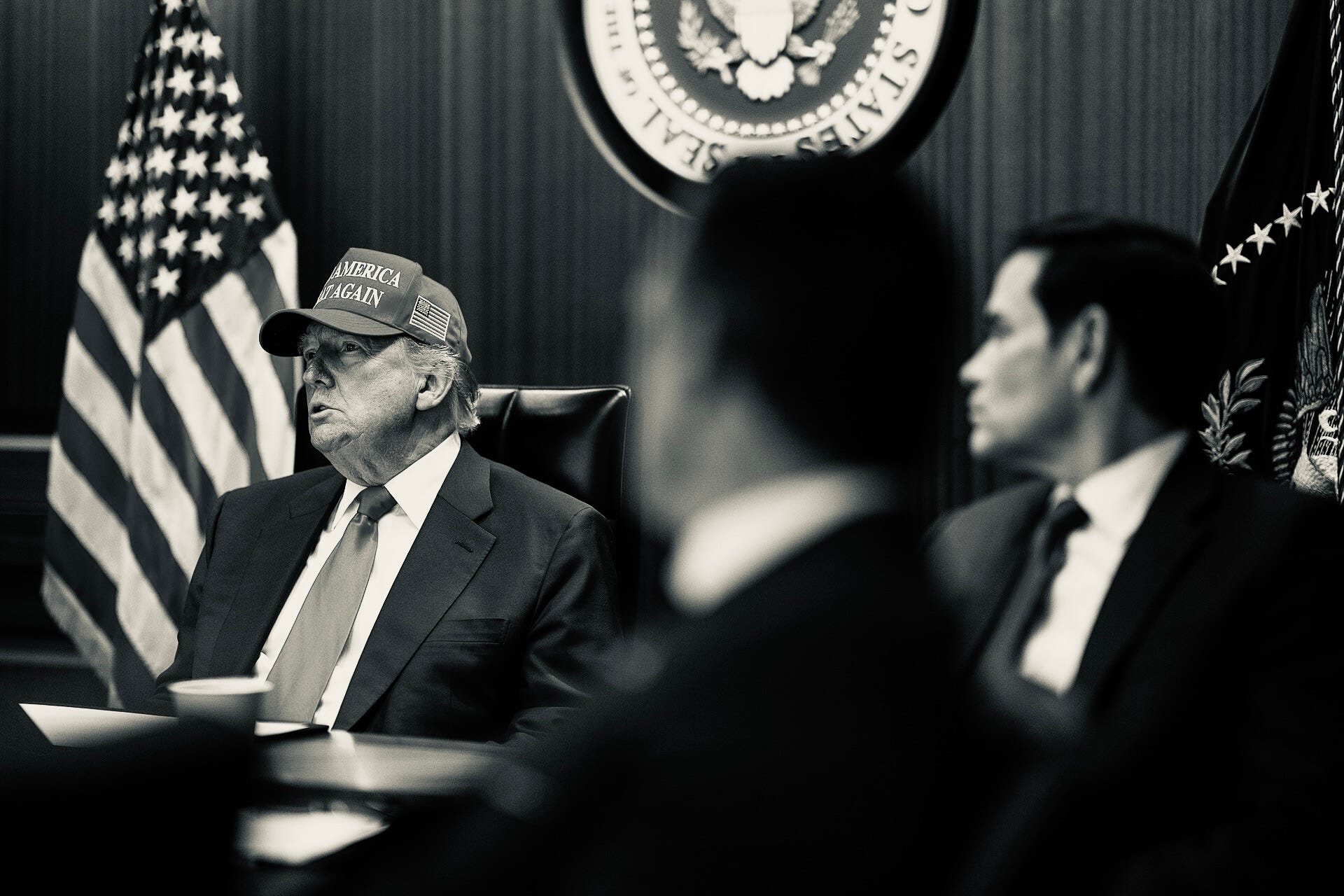
In Donald Trump’s first year in office, the United States came closer to a nuclear conflict than most people realize. His mishandling of the confrontation with North Korea was so serious that our team at the Department of Homeland Security (DHS) was forced to do real-life, defensive planning for the possibility of a nuclear strike against the homeland — a situation DHS had never been in since its creation.
As the president barrels forward with the Iran war, I’m getting the same sense of dread that I had then. The Russians and Chinese are joining the conflict. Threats to the homeland are multiplying. And Trump has mused about testing nuclear weapons. But this time, we are far less prepared for a “worst-case scenario.”
It started as a routine afternoon, as routine as anything could be in the chaotic first year of the Trump administration.
It was late November 2017, and I was in a doctor’s office. Like a lot of others, I’d put off anything related to my health for months while grappling with the disorder inside the administration. There was no time to go to dental cleanings or annual physicals or even to treat a sprained wrist. So on a rare quiet day, I slipped away from DHS for an appointment and briefly silenced my phone. At the time, I was responsible for leading intelligence and counterterrorism planning, so even a doctor’s visit felt like a vacation.
Midway through the appointment, I tapped the screen just to check my messages. It lit up with a cascade of missed calls and alerts. Something was wrong. I opened my email. When I realized what had happened, my adrenaline spiked.
I told the doctor I had to go.
Racing back to DHS headquarters up Embassy Row, past the cop cars and the embassies of a dozen nations, I got on the phone with the DHS switchboard. I told them to put me on the line with the DHS secretary. They said they couldn’t reach her. She was underground — in a secure facility — and they weren’t at liberty to say more on an open line.
I knew. The moment I saw the alerts, I knew. So I accelerated.
When I finally got back to the building — through the security gates, checkpoints, and a series of guarded doors — I found Acting Secretary Elaine Duke. She was in a conference room, surrounded by papers marked with bright-orange cover sheets. The words TOP SECRET. Grainy satellite photographs scattered across the table.
North Korea had launched an intercontinental ballistic missile. The Hwasong-15. The reclusive regime’s most powerful weapon yet — the first North Korean missile capable of hitting anywhere in the world, including Washington, D.C. Right where we were sitting. Elaine had tried to find me before going underground to monitor the situation. In those early moments, she had wondered whether this was a North Korean “test” or whether this was “the big one” that we all feared.
The president had been tracking the launch, too. And he had called Elaine while she was managing the crisis. Thankfully, it turned out to be a test. But Trump wasn’t calling to ask about the missile — or even whether his defensive team at DHS was ready to protect the homeland against such a strike had it been the real thing.
He wanted to talk about deportations.
In an angry phone call, the president told the DHS chief to “deport them all.” His mind was on migrants. Specifically, Trump was musing about ending the Temporary Protected Status program, which allowed people from disaster-stricken countries to remain legally in the United States. More than fifty-seven thousand Hondurans alone were living in the country under the program. Trump really wanted them gone.
As Elaine recounted the call to me, her eyes began to well up. A nuclear-capable missile had just ripped through the skies over the Pacific, and the president of the United States was oblivious. All he cared about was getting foreigners off his land.
“It’s so broken,” she confided. “This isn’t why I came back into government.”
I knew exactly what she meant. We were in even deeper trouble than I thought.
What the public didn’t know at the time — and until years later — was that the president’s team was worried he might start a nuclear war.
Since its creation after the September 11, 2001 attacks, DHS had never been in the position it found itself in during the fall of 2017 and spring of 2018. We weren’t just running table-top exercises or updating Cold War-era contingency plans as a matter of bureaucratic routine. We were preparing for the genuine possibility that this president — our president — might stumble us into a nuclear confrontation with North Korea.
Indeed, even his closest advisors didn’t know what the president would say or do from one day to the next. Trump mused to some of them, like White House Chief of Staff John Kelly, that he badly wanted to strike North Korea. He wasn’t playing some elaborate strategic game, as his devoted followers thought, by performing the role of madman to rattle Kim Jong Un. Aides worried he was genuinely prepared to take America into what could have become history’s first two-sided nuclear war.
In angry tweets, he threatened North Korea with “fire, fury and frankly power the likes of which this world has never seen before.” National security officials woke up to these messages on their phones. Stunned. The president almost seemed to welcome the prospect of a global conflagration.
Defense Secretary Jim Mattis pulled me aside after a contentious White House Situation Room meeting and delivered a warning that still echoes in my memory.
“You all need to prepare like we’re going to war,” he said.
He was not speaking in metaphors.
So we convened every top leader at DHS over the span of months. Experts walked us through scenarios, including nuclear strikes against the American homeland. They dusted off response plans. They outlined best-case outcomes that still sounded horrific. I cannot provide the details, but we walked out of those meetings not as bureaucrats who’d completed a checklist, but as mortal and frightened people.
States like Hawaii had already quietly reinstated their public alert systems for nuclear attack for the first time since the Cold War. And a few months later, that proved prescient. Hawaii accidentally sent out a public warning that a missile was inbound, sending residents fleeing in terror. They weren’t the only ones on edge. Whenever we got alerts that the North Koreans were preparing a missile launch, those of us working inside the administration worried it could be the real thing… or that the president might say something so stupid that he’d manifest it… or that he would be too distracted to care.
When I think back to what kept us from catastrophe during that period, the answer is painful in its simplicity. A small number of people were willing to tell Donald Trump the truth. People like John Kelly, Jim Mattis, and a handful of others.
The so-called “Axis of Adults.”
They didn’t see themselves as “heroes.” They saw what they did — speaking truth to power — as a bare minimum expectation for a public servant. In the end, they steered the president away from a direct confrontation with North Korea that could have gotten Americans killed. Many Americans. Advisors were willing to tell him the bad news and warned him of the repercussions of baiting the North Koreans into a direct confrontation (even when he seemed more interested in deportations than the national-security consequences of his tweets).
Most people who go into the upper echelons of government know that one of their most fundamental responsibilities is to tell the big boss what he doesn’t want to hear. Sometimes that might mean standing firm when ideas are illegal or simply pushing back when proposals are misguided or reckless. In rare instances, when he’s unmoved, it might mean desperately finding ways to redirect the president’s attention away from pathways that are cataclysmic.
Trump eventually did a full, 180-degree turn on North Korea, from confronting Kim Jon Un to fawning over him. I’ll admit that the “love letters” Trump sent to Kim were grotesque. Coziness with such a brutal dictator was a betrayal of decades of American policy toward an authoritarian state responsible for the imprisonment and deaths of hundreds of thousands of its own citizens. The affection made America look weak and naive on the world stage.
But love letters were a whole lot better than nuclear war.
I’ll take naive and embarrassing over radioactive any day.
As the world grapples with Trump’s war in Iran, here’s what hasn’t changed: Donald Trump.
He’s just as impulsive today as he was in 2017. Just as reckless. By all recent accounts, staff are still kept in the dark about his intentions and don’t know from one moment to the next whether he’s going to pull back from Iran or double down. That means they’re unable to prepare. In fact, he reportedly has no more interest in advance planning or scenario modeling than he did eight years ago.
So what has changed? Sadly, the answer is this: everything that kept him in check.
However imperfect, there are no John Kellys and Jim Mattises around the president today. Whatever limited guardrails that existed are gone. In their place is a court of loyalists telling the president what he wants to hear, a group of shit-posting social media jesters hyping him up by making the war feel like a dopamine-fueled video game, and weirdly, cabinet secretaries who won’t even tell him “no” when he insists they wear the same shoes that he does, including when they’re the wrong size.
On preparation, we can confidently say that the administration went into a war with Iran woefully unprepared, at best. According to reporting, senior officials admitted to lawmakers in classified briefings this week that they had not even planned for Iran to close the Strait of Hormuz, which is the scenario that is now playing out and threatening energy supplies worldwide. In normal times, this would have been an obvious consequence. Hell, the “war games” we did in graduate school on this exact subject included such a scenario.
Equally galling, the president got us into this war with one hand tied behind America’s back. He knew that DHS — the department responsible for playing defense when America is at war — was effectively shuttered. He did little to broker a deal to reopen it. As of this writing, DHS remains largely closed amidst a budget fight on Capitol Hill. Many of the people who should be safeguarding our shores or sitting in secure rooms, day after day, modeling how this conflict might escalate and reach us (like we did in 2017) are sidelined.
On speaking truth to power, I’m even more alarmed. A New York Times story earlier this week contained a single quote that made me want to sit down and write this essay in the first place. Here’s what the Times wrote:
“Inside the administration, some officials are growing pessimistic about the lack of a clear strategy to finish the war. But they have been careful not to express that directly to the president, who has repeatedly declared that the military operation is a complete success.”
Give that a read again.
White House advisers are being “careful not to” speak truth to power. Careful not to.
Trump’s war is imperiling the global economy, spiking gas prices for working Americans, and putting lives in danger in the region and here at home. And the people closest to the president don’t want to offend him by seeming concerned.
I understand why his loyalists won’t stand up to him when he’s using the presidency to bully his enemies or to settle personal scores. Grimly, I’ve come to accept that we live in a world where that kind of cowardice is common. But they’re too scared to warn about a great recession? Too scared to tell him that he’s pushing the dominos toward a broader global war? Too scared to tell him that the Russians and Chinese entering this conflict is a sign it’s spiraling beyond his limited imagination?
My fear about this man has always been about his finger on the nuclear button. That’s usually just symbolism when we talk about the presidency. The “nuclear button” is a stand-in for the concept of presidential power and the risks of instability.
When we’re talking about Trump, it’s not a metaphor.
His recklessness with North Korea during his first term put America in a dangerous and unprecedented position. Worse than many realized at the time. While Iran is not yet a nuclear power (as far as we know), the situation is no less volatile. According to estimates, the Iranian regime has enough fissile material to construct eleven nuclear bombs. Trump’s own envoy to the region, Steve Witkoff, said it would be relatively easy for Iran to build a device similar to those the United States dropped to end World War II. He even speculated that Iran could use its stockpile to create dirty bombs.
Yet far from fearing nuclear conflict, the man directing this war has an eerie fascination with nukes. Almost like the kid told not to touch a hot stove who can’t help himself. That should give us pause.
In his first term, Donald Trump mused to aides about the possibility of the United States using nuclear weapons to conduct an attack and just blaming it on another country. After leaving office, he reportedly removed classified documents related to U.S. nuclear secrets from the White House. And back in power, he has resumed his fascination with U.S. nuclear weapons by toying with the idea of setting one off.
Late last year, the president went on Truth Social and raged about how other countries were testing their nuclear bombs while America wasn’t. Indeed, the United States has maintained a moratorium on nuclear testing since the end of the Cold War, a commitment that’s been a cornerstone of global nonproliferation efforts and has kept the world from unraveling. Trump was ready for that to change.
“Because of other countries testing programs, I have instructed the Department of War to start testing our Nuclear Weapons on an equal basis,” he wrote in a social media post. “That process will begin immediately.”
Regardless of what happens with the Iran war, I want you to remember this. I want you to remember what we’ve learned about how Donald Trump sees his gravest responsibilities as commander-in-chief, how he was gamified war, and how he has flirted with nuclear catastrophe. It is, perhaps, the most urgent reason for Americans to demand the other branches of government do more to keep him in check. Our president is unstable, and there are no longer sensible people around him to send up a flare if he’s ready to do something deadly.
If there were, we probably wouldn’t be at war right now.
Your friend, in defiance,

You got it all in the conclusion. "Our POTUS is unstable and there are no sensible people". He is a criminal that has surrounded himself with other criminals. Bondi will chase anyone, Patel will try to change history, Hegseth loves playing war with Trump, Vought is ready to spend money on anything, Miller keeps lying about the economics of detention, the Federalist Society of unethical lawyers look the other way as the judicial system is destroyed. All this is about money and Epstein; the corrupt Congress and government hides Epstein and their investments in Palantir, Corecivic, Geogroup and the military. McConnell noted that Trump was a criminal - he owes us an effort to correct it. And Grassley has done nothing but protect the corrupt SCOTUS and ignore all his responsibilities as Senate Judicial Committee leader. And now ICE torments Vermont.
……….FUCK……..