


I know a man who spent years doing what most people only talk about doing. He was a David who stood up to a Goliath and won. But then Goliath returned unexpectedly. And David ran for the hills.
The person about whom I’m writing is a face you may recognize. Maybe not. But surely you’ve heard his voice, at some point. The man is someone who helped chase Donald Trump out of town after his first term, went on television when it was uncomfortable, and said, in public, what most people in his circles said only at dinner tables with the doors closed. When Trump was indicted, he decried the ex-president’s treachery. He warned us never to elect such a criminal again.
Then Trump was re-elected.
The threats didn’t arrive in the mail in a bright red envelope. They rarely do. The man received threats in more subtle ways — the kind that Washington has always known how to send without committing anything to paper. The man heard murmurs of investigation and litigation and prosecution. All the scary -ion’s. People reached out to ask him if he was scared. The man had committed no crime, at least he thought he hadn’t. But the phone calls made him uneasy. Allies of Trump spoke his name.
He’s a smart man. He received the message clearly.
What happened next was not, strictly speaking, a surrender. The man would bristle at that word, and I think part of him would be right. He didn’t march out to any podium to recant. He didn’t publish an apology or offer his services to the people he’d spent years opposing. What the man did was quieter and, for me, more dispiriting. He faded away. While America lurched loudly into its present disorder of the second Trump administration, he tip-toed back from the public eye. No one’s had time to think about him since. I know, firsthand, that the man is relieved about this.
What Donald Trump has done — and this may prove to be his most consequential gift to political science, if not to democracy — is create a “social fork” in American life. He’s come for people and institutions so broadly, persistently, and with such malevolence, that virtually every corner of American life has been forced to answer a question about themselves they’d have preferred to leave unanswered.
The question is simply: which way will you go?
It’s not a trick question. There are not multiple paths. In my experience, there are just two. When confronted with the heavy hand of a tyrant, you can turn left and choose self-preservation — at least in the sense that you avoid criticism, attack, investigation, or merely association with the damned. Or you can turn right and choose principle. But doing that means accepting short-term costs, sometimes serious ones, with the faith that principle is the only self-preservation worth having in the long run.
To be clear, I’m not talking about the political Left and the political Right here, with capital L’s and R’s. I’m just talking about going one direction that leads to the false comfort of capitulation, taking a left-hand turn, and another direction, which I call “the right,” that looks at first glance like a bumpier road.
Consider what happened to the great universities last year. These institutions spent decades assembling the most elaborate vocabularies of resistance. Whole academic departments were devoted to the architecture of dissent! Many of the Ivy League schools even have endowments built in part on the premise that they’re the guardians of open society. Their presidents gave speeches about “free speech” and built associations dedicated to “free association.”
Then the subpoenas arrived from the Justice Department. The White House delivered scathing funding threats. Trump tweeted their names. And all those university presidents got phone calls from trustees who’d done the math. “We should lay low,” they said. “We can’t afford this fight.” I presume many of those university presidents have comforted themselves that the decision to stand down wasn’t really their own decision. They had to heed the trustees, after all. They had to do “what was right” for the institution.
Columbia negotiated.
Harvard held out, then made its own calculations about what holding out would actually cost.
Then the dominos really fell.
Brown settled. Cornell capitulated. The University of Virginia threw in the towel. Many, many other universities raced to cut deals with the administration before their names were even on the chapped lips of those young, energy-drink-pounding Trump appointees, many of whom had only just graduated from those colleges before taking jobs they didn’t know how to perform inside an administration that only measures performance by piety. I had the dishonor of working with such “public servants,” who seemed only to care about the “servant” part.
So yes, the great universities of America turned hard left.
The law firms were even more naked about it. Several of the most prominent legal institutions, whose managing partners spent years performing civic-minded, virtue-signaling exercises about fighting oppression, barely lifted a finger. They settled fast. Legal titans who’d donated tens of thousands of dollars to oppose Donald Trump begged the White House not to sanction them (begged!) and agreed to donate millions to perform legal work on behalf of Trump. People who months earlier had been eyeing jobs in Harris administration — and probably sneering at Trump voters — were now desperately offering to help Trump implement his agenda, lest he penalize them.
But some turned right. They’re not famous for it. At least not yet. The law firm settlements got the press coverage. But some of those early refusals were serious legal professionals who looked at the consequences and then looked into their own souls. They decided not to sell out. In doing so, they set in motion a series of events they couldn’t have expected. In short, they made it easier for others to refuse.
After a few law firms refused to bend the knee, they got punished for it. They were hit with executive orders from the White House. But they struck back. They sued Trump in court. They won. And when they turned down the path to the right, they showed the wary few peaking out from the bushes that the path wasn’t going to be lonely. The rest is history.
After that, some of the people Trump went after individually felt more emboldened to fight back, including former officials, Democrat leaders, and critics. Comedians who were threatened by the FCC decided not to pull their jokes off the air. Civil servants who were told they’d be fired if they said a word instead decided to risk their jobs by signing open letters, building a record of Trump’s abuses of power with the patience of people who believe that records will eventually matter again.
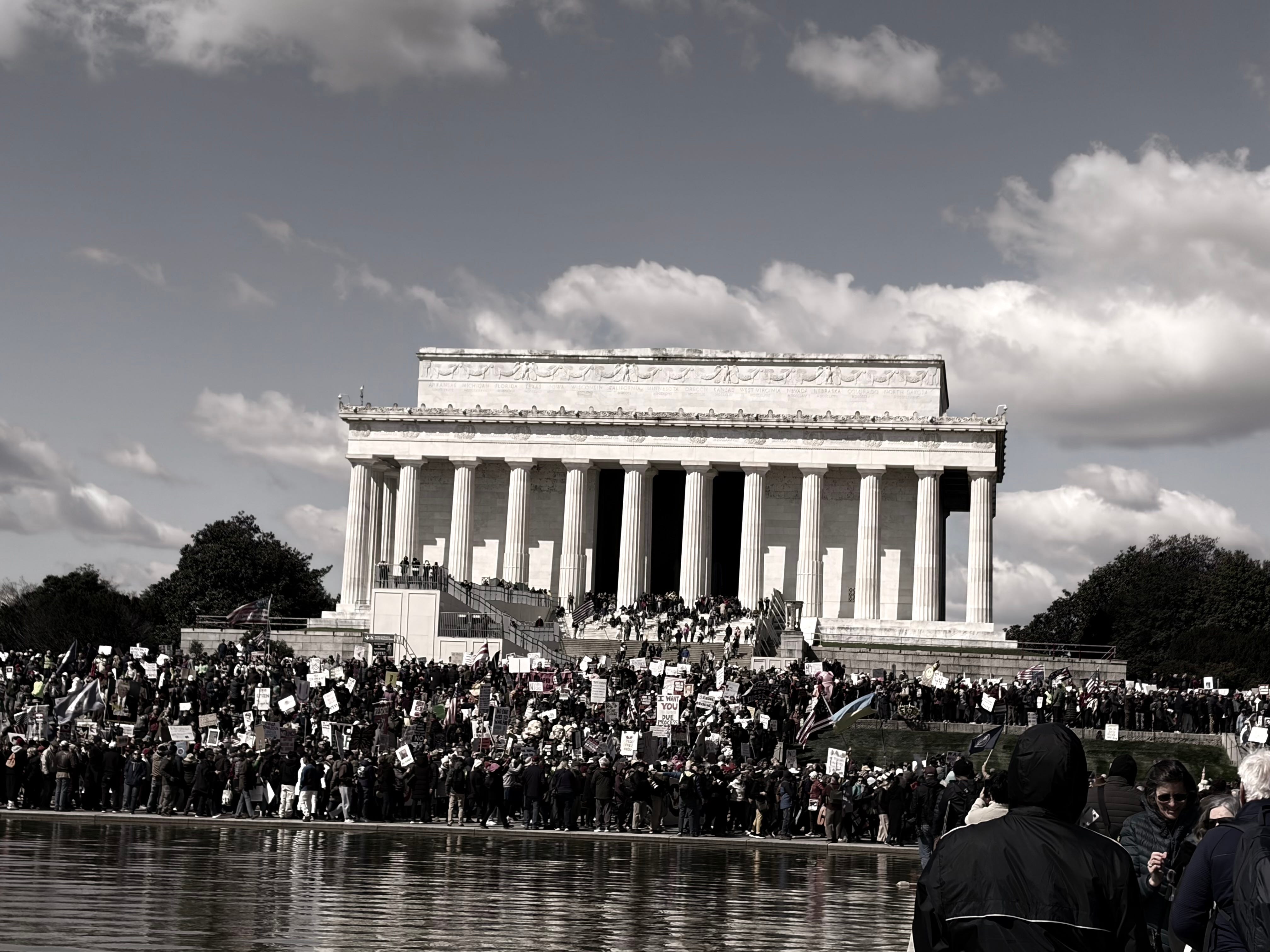
Then, there were those of you who showed up this past Saturday at No Kings Day III. You chose the pathway to the right. In fact, you’re part of a growing herd marching down the road that used to look quite treacherous. In time, it’s going to make the people who walked to the left feel exposed. Eventually, they’ll feel just like the early right-bound trailblazers felt. Alone. And that, my friends, is when democracy’s heart starts beating again, i.e. when a principled stand creates “FOMO,” or “fear of missing out.”
This is the social fork of Trumpism. I’ve been watching it operate at close range. After the White House put me under federal investigation a year ago, I discovered (with a precision and specificity I had not expected) who among my friends, mentors, and professional acquaintances had, in their own private accounting, already turned left. Not all of them announced it. Some simply became unavailable. Some were warm in private and silent in public. They didn’t sign the support letters or post messages of solidarity. Some offered the language of loyalty at low cost with a check-in texts, while carefully managing the visible terms of their association with me.
I’ll have more to say about that in the months and years to come. I’ve learned a lot, in fact, that I want to share with you. I learned things I couldn’t have learned any other way, including about the people around me and about what the mechanism of targeted pressure actually does to human beings who are desperate not to be tested. It clarifies. That’s, perhaps, the one generous thing I can say about it.
If America comes through all of this, which I believe it will, it won’t be because the institutions held. Most have not. In reality, it won’t even be because powerful people were particularly brave. Most were not. They chose calculated self-preservation over principle. America’s perseverance through this ugly period will be owed to ordinary people, like you, who turn to the right.
Remember “the man” I mentioned earlier? Turns out he wasn’t so much of a man as he thought. Upon re-reading the above, I realize the passage could apply to at least a dozen figures who stood against Trump when it was easy and withered when it was hard. The loudest voices in any fight are not its bravest. Sometimes they’re just loud. I’ve found that the truest claimants to the title of “courage” don’t wear it as a badge at all. A lot of times they eschew the term. Instead, they earn it with choices made in private when no one is watching and when all the standard calculations are pointing in the opposite direction.
The man I wrote about made his choice. I don’t entirely blame him. But I’ve not forgotten it.
I’m looking over at my bookshelf in my office right now. And it’s pretty clear to me that the version if history that wins the day is definitely not written by people who cowered and came out the other side to explain, with great insistence, “I kept my head down because it was actually a more sophisticated form of resistance.” History seems to be made by the people who believe there’s something worth more than comfort.
You may be reading this and thinking you’ve already made your choice. I thought so, too, and so did the man I described earlier. But guess what? The choice is not made once. It’s made over and over again, every day that this American crisis continues. Every morning, that damn fork is there again.
Which way are you going?
Your friend, in defiance,

A million likes for this fabulous essay. Bravo, Sir, bravo!
“The choice is not made once. It’s made over and over again, every day that this American crisis continues. Every morning, that damn fork is there again.”
Until my last breath, I will stand for the United States where all peoples should be treated with dignity and respect. Our country has never been prefect and never will be. But we can do better. And we will.