


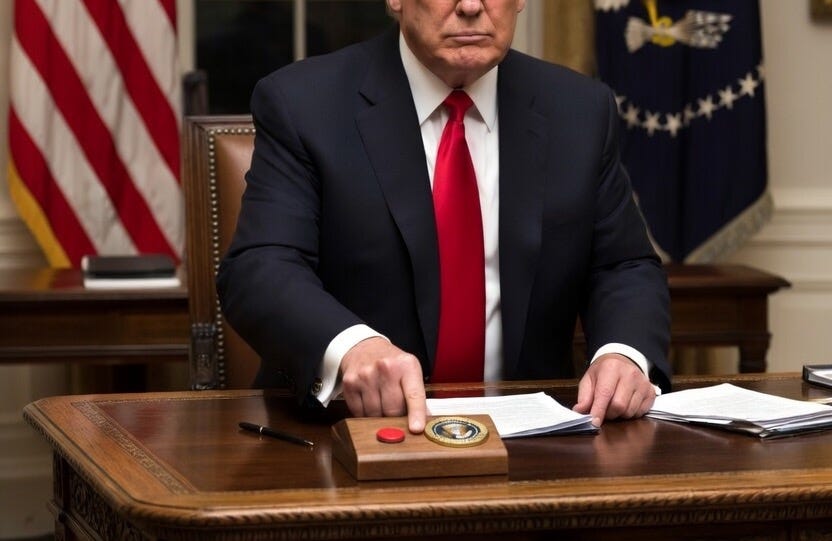
Years from now, if the world order collapses, historians will trace it back to something more mundane than a nuclear war or a deadly pathogen. “It began,” they’ll write, “with a single man’s insatiable need for chaos.”
A weapon of mass distraction, if you will.
I watched that “weapon” get built, up close, during my time at the Department of Homeland Security. There was hardly a day we were allowed to focus on our job of protecting hundreds of millions of Americans. Instead, more days than not were spent scurrying around Washington, dealing with the fallout of foolish presidential missives.
As an example, let me tell you about Friday, December 21, 2018.
I walked into the Oval Office for what should’ve been a straightforward win. Donald Trump was about to sign legislation I’d spent years helping craft and which we’d painstakingly gotten across the finish line in Congress just before the holidays. It was a sweeping government overhaul to ramp up efforts to detect weapons of mass destruction (WMDs) — nuclear material, engineered pandemics, and the dangerous new threats that technology was creating. It was a bipartisan, historic effort.
As usual, Trump had no idea what he was signing. I walked up to the Resolute Desk and launched into a briefing on the looming WMD dangers of the near future. I knew he didn’t absorb his intelligence briefings. But maybe if I sketched out the scenarios with enough doom and gloom, he’d pay attention. He nodded blankly as I spoke. My words seemed to blow through his ears like air conditioning.
There’s no way he understood what I just said, I thought. Afterwards, he didn’t ask questions. Then he looked around the room and changed the subject.
His thoughts weren’t on homeland security that day. In his signature electromagnetic impulsiveness, Trump was focused on fresh controversy.
The president had just sent U.S. allies into a panic by tweeting — from the White House residence, against military advice — that he was pulling U.S. troops out of Syria and Afghanistan. For Defense Secretary Jim Mattis, it was the final straw. Fed up with watching life-and-death decisions get made by tweet, he announced he would transition out of his job in February. What did we think of Mattis? Trump wanted to know. He was scheming to “fire” the Pentagon chief before that transition. Just to spite the former Marine. In fact, Trump wanted to do it before New Year’s Day.
Even that topic couldn’t hold the focus of his microwave mind, where his thoughts and ideas popped off like corn kernels. Soon he was ranting about the border wall, as WMD experts filed into the room for the actual bill signing. He’d just announced, on a whim, that he planned to veto a bipartisan spending bill and shut down the government because Republicans hadn’t worked hard enough to get him money for his border wall. Hours earlier, Trump’s decision had rocked Washington. His agencies (including our own) were now scrambling to shift into emergency-operations mode, days away from Christmas. No one had expected a shutdown.
As he gloated about the surprise move, Trump seemed oblivious to the fact that the nuclear detection experts who’d come into the Oval Office for this celebratory moment were now worried. Would they be able to implement this bill Trump was about to sign? Would they even be allowed to come into the office next week? Would they get their next paycheck?
Eventually, Trump uncapped his Sharpie and squiggled his name on the bill and took a few pictures. Grinning and putting his thumb in the air. Once again, I tried to bring his attention back to the issue at hand. WMD threats. The urgency. What we could do about it, even before his signature finished drying. Blank face. He wasn’t processing what I was saying. I probably would’ve accomplished more by singing French lullabies to a pillow on the couch.
Trump diverted again. He started complaining about the Mueller investigation — a subject with zero relevance to anyone in the room.
“Can you believe this is still happening?” he blurted, clearly stuck on some headline from earlier in the morning. “A complete hoax. A witch hunt.”
Alright then. That’s enough, I concluded. I tried to shoo the career employees out of the room after they’d each gotten their photo. We’d learned the hard way. The longer you stayed around Trump, the more likely you were to leave holding the bag of a bad idea, a silly presidential side quest, or an order you couldn’t follow, unless you wanted to begin your post-government career in prison.
Afterward, I walked down the hall to the Chief of Staff’s office. John Kelly hadn’t even bothered to come to the bill signing. He announced two weeks earlier that he was quitting, too, and I couldn’t blame him. The conditions around Trump weren’t compatible with governing. I sat on the couch outside his office and jotted words in my notebook.
Weapon of Mass Distraction.
That was biggest homeland security threat we faced. Time was running out to sound the alarm.
That day in December was almost tame in comparison to the crises we’ve watched the president foment ever since. But it crystallized something I’d been struggling to articulate: the problem with Trump’s near-pathological obsession with spectacle and self-imposed controversy. The unseen consequences.
What happens in the immediate is obvious. Donald Trump spews “distraction radiation” on everything around him. He does this to federal agencies, the press, the public, and our allies around the world. Like actual radiation, it can have severe immediate-term impacts that everyone rushes to address. But it gets worse as time goes on. Other systems start to fail until, eventually, all of your productive effort is subsumed by the symptoms and the after-effects.
In government, time is a very finite resource. A Cabinet secretary has roughly ten productive hours in a working day. Every hour spent managing a presidential tantrum, untangling an illegal directive, or responding to a manufactured crisis is an hour not spent on the country’s real problems. Then the damage spreads. When someone as reckless and sleepless as Trump is firing off missives from 9 p.m. to 4 a.m. — like he did this past Sunday night — the blast radius grows wider. While you’re frantically responding to his social media sensationalism, the actual work you ignored becomes another emergency. Then it can’t wait any longer.
Suddenly, all you’re doing is crisis response. Lurching from one disaster to the next.
During the first Trump term, the biggest national security issues in a generation went unaddressed. Take, for example, the rise of A.I. When Trump took office, it was evident to most of us in the national security community that A.I. was poised to reshape our world. We were woefully behind. We talked about it in urgent tones at interagency meetings, making plans to overhaul entire departments. Those meetings kept getting postponed, then abandoned. It became “next quarter’s priority.” Again and again.
Today, America is far less prepared than it should be. It’s hard to overstate how many matters like this were ignored because Trump dropped a distraction bomb.
Throughout DHS, there were management challenges big and small that demanded our time, like the U.S. Secret Service. For years, agency insiders warned that “modernization” was needed, or something terrible would happen. Agents were burnt out and under-resourced. It was on everyone’s to-do list. But real reform required sustained focus, and focus was the one thing Trump made impossible. Senior DHS officials weren’t spending our days “modernizing” agencies. We were getting berated to find legal cover to deploy federal shock troops into Democrat-run cities or to arrange gun-toting photo ops at the border.
Chaos has consequences. Even the most basic reforms at the Secret Service might have helped catch the shooter in Butler, Pennsylvania who tried to assassinate Donald Trump himself. The irony is not lost on me.
This is what a Weapon of Mass Distraction actually does. The fallout is more than mere “wasted time.” It literally warps priorities across the entire policymaking apparatus until the cacophonous noises of a narcissist become the entire focus of federal employees. Meanwhile, true dangers lurk in the background.
In Trump’s second term, his WMD has been upgraded. No target is spared. No hesitation is displayed.
As I write this, America’s closest allies are quietly stress-testing fuel reserves and supply chains, bracing for the possibility that the Iran conflict (which almost no one outside the White House and Israel wanted) tips the global economy into crisis. Defense ministers are fielding demands from Washington to send ships to the Strait of Hormuz as a loyalty test to Trump. Or else.
Meanwhile, China and Russia are consolidating gains across every domain where American has closed its eyes. The most important technological reckoning in human history, i.e. the emergence of A.I. as an existential challenge to our species itself, is unfolding without serious Western action. The bandwidth simply isn’t there. Every week brings a new Trumpian act of vanity, moral absurdity, or power-wielding calamity. Once again, roomfuls of people — whether it’s a newsroom or a boardroom or a briefing room or a classroom — turn their attention to the billowing mushroom cloud Trump has sent into the sky, instead of what they should be doing.
I used to worry about real-life WMD. It was a top-three priority for me when I went into DHS during the Trump administration. Then it nearly fell off the list. What I didn’t fully anticipate was the deadlier weapon the president was wielding. While he didn’t launch literal nuclear strikes against the American people, he consumed the attention of everyone responsible for keeping them safe. And by turning the most powerful country on earth into a perpetual PR and crisis-management operation, Donald Trump left all of us naked and exposed to danger.
Future historians, if they’re in a position to write anything at all, may find this the most confounding chapter of the American story. Yes, a would-be autocrat tried to seize and consolidate power. That was terrible. But it wasn’t what did America in. What they’ll marvel at is how Trump managed to detonate the house while everyone was busy watching him throw matches into the front yard. The distraction became the weapon.
Of course, it doesn’t have to be this way.
If you want to disarm Trump, I can help you. In fact, I can tell you exactly where codes are, how to enter them, and precisely when to push the button. First, you need to find your nearest polling place. Second, you must look up which candidates Donald Trump has endorsed this year — and who’s running against them. And finally, you must get to the polls on November 3rd to cast your ballot and defeat his democracy-destroying coalition before it’s too late.
That, my friends, is how you dismantle an atomic bomb.
I’ll see you there,

P.S. What’s coming up? We’re full-time focused on saving the republic. Join us for our next broadcast. Watch LIVE for free. Members get access to the replay.
DEFIANCE DAILY — Every weeknight @ 5pm ET. Watch our hour-long podcast LIVE on our DEFIANCE.News page, on our YouTube channel, or on my X account. Or you can watch the replay at DEFIANCE.News.
WEEKLY MISSION BRIEFING — Every Wednesday @ 5pm ET. Same ways to watch, above! Replays available afterwards.
WEEKLY COFFEE — Every Friday @ 2pm ET. Join us on Substack or at DEFIANCE.News for Members-only coffee every Friday at 2p ET. Replays available afterwards.
MONTHLY MEMBERS-ONLY MEETING — First Wednesday of every month @ 5pm ET. These are sent out the week of, via Zoom. Replays available afterwards.
"It began with one man's desire for chaos."
I could make an even more compelling argument involving Freud that's its more about one man trying to make up for certain obvious physical (and mental) shortcomings which keep manifesting themselves as ‘missile envy.’
I distanced myself from a covert narcissistic father as a young adult. It was a great mental health decision at a time before NPD abuse was not widely understood. Now, I feel like my country is being held hostage by a far worse character, a malignant narcissist cosplaying mob boss-POTUS and his Machevallian flying monkeys. Voting en masse " too big to rig" in November is a matter of life or death.