


Read Part I here - Restraint.
Read Part II here - Dissent.
Read Part III here - Separation.
IV. Allegiance
You stayed. Good. Against your better judgment and mine, you’re still on the promenade, looking up at a structure that we’ve decided no honest inspector would certify. We’ve walked past three failing or fallen pillars now, including the restraint that’s supposed to bind the ruler in the United States of America, the dissent that sounds the alarm if the ruler strays, and the separation of powers that should enable someone to respond to that alarm once it’s sounded.
Notice something in common. Whether those columns have stood, albeit barely, or crumbled has been decided by mere individuals. There’s no invisible hand guiding our democracy into the future. There are only fallible people. A president deciding whether or not to show restraint. A public servant weighing whether to disclose wrongdoing. Or a judge deciding to defend his or her prerogatives, despite knowing that an honest ruling will be met by one man’s unyielding vitriol. If you strip away the marble and the parchment, the whole republic rests on individuals — put to the test.
A question will soon stalk an even greater number of them. When an order is unlawful, do you keep faith with the Constitution, or with the man? In our 250-year history, most Americans were never confronted with this question. Until now. Some have already been forced to answer, but it will likely be put to millions of them before the current regime ends. As such, no one should be watched more closely than the government workers who — even if they’re too afraid to dissent — must still decide whether to obey. Is it scarier to defy the law… or to defy the man?
This is our fourth pillar. Allegiance.
If the leader of a democracy decides he’s now a tyrant, it doesn’t make the system a tyranny, not right away. Like the emperor who has no clothes, he may see himself as one thing but be seen as another. Perhaps an aging fool. So long as it’s only him (and maybe his most committed courtiers), the danger of a self-styled despot becoming the real thing has limits. He’s an “insider threat” to the rule of law, to be sure. But that’s no guarantee of the law’s demise. If the masses of appointees and civil servants and soldiers side with the tyrant, on the other hand, then the whole polity is on hospice.
America is unique in this respect as well. For thousands of years of human civilization, you swore fealty to the king or the emperor. As we’ve discussed, loyalty flowed upward to whoever wore the crown; to break it was the highest crime there was. The American Revolution’s most radical act was to sever that cord. Here, for the first time, allegiance would run not to a man but to a document and an idea. The soldier and the official would swear oaths to “support and defend the Constitution,” and to no person at all.
By giving power away, one man made that real. In 1783, at the height of his fame and the apex of his power, with an army that adored him (and at least one officer who floated the idea of making him king), George Washington walked into the Maryland State House, resigned his military commission, and went home to his farm. He did the thing no victorious general in probably two thousand years had done. He handed the power back. Later, he would walk away from the presidency, as well, refusing another term when he could have held office for life.
When King George III heard that Washington intended to surrender his command, the king said that if he really did it, “he will be the greatest man in the world.” In the world George III knew, that was unthinkable. Power was something you clung to until death. Washington’s allegiance, however, ran to the republic. By letting go of his authority, he taught a new nation that the office is a trust and not a throne. His most recent successor did the very opposite.
You can find no more symbolic bookends for America’s 250 years than this. One man at the nation’s outset, ceding his power out of restraint. Another, in our present time, so unwilling to give it up that he’s already attempted to subvert a democratic election and prevent the peaceful transfer of power. And he may be preparing to do it again. We know where his loyalties lie; it’s why the first pillar crumbled.
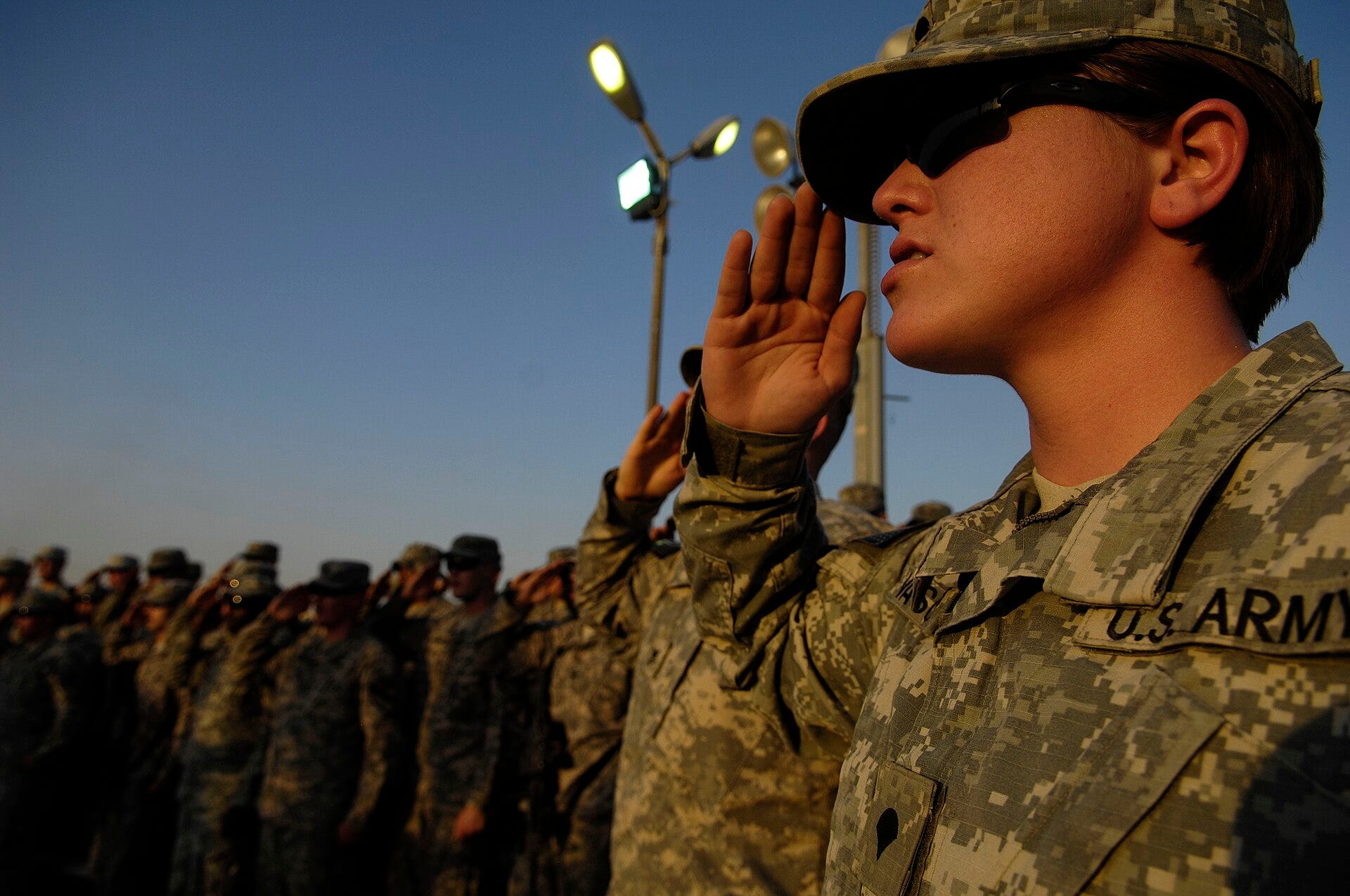
The allegiances of ordinary men and women may determine our future. The damaged pillars have shifted their weight over to the people who carry out the work of state. How should they declare their allegiances? The right answer is self-evident. The soldier’s oath runs to the Constitution and not the commander. Every service member is trained on the rule written in blood at Nuremberg. “I was only following orders” is not a defense for an unlawful act. Allegiance to the law comes first in every corner, command, and cubicle of the military and civil service.
Don’t most schoolchildren repeat this while holding their hands over their hearts? Is it not an elementary concept? Not anymore, it appears.
In November, six members of Congress recorded a ninety-second video. Every one of them had served in the military or in intelligence, including a Navy combat pilot, a CIA officer, and an Army Ranger. They spoke directly to the men and women serving now, and merely repeated the notion written above. An oath is sworn to the Constitution, they said in their video, adding: “You can refuse illegal orders. You must refuse illegal orders.” This is hardly radical. It’s printed in the training manuals of every single soldier in the force.
Yet for saying it out loud, the president of the United States called them traitors and declared their words “SEDITIOUS BEHAVIOR, punishable by DEATH.” He called for them to be arrested and tried. He reposted a message from one of his followers that read: “HANG THEM GEORGE WASHINGTON WOULD.” And his Justice Department sought to bring charges against those elected Members of Congress for restating a 250-year-old idea of “allegiance.” (As of this writing, the only reason charges haven’t been filed is that a grand jury of everyday Americans told corrupt prosecutors: “NO.”)
In the United States of America, on the eve of its semiquincentennial, allegiance to the Constitution has been rebranded as treason. Allegiance to the man has been rebranded as the “allowed” form of patriotism. Is there a cleaner portrait of civic perversion?
John Dickinson, dubbed the “penman of the Revolution,” watched the English system trend this direction before he came to the American colonies. Men can become so hungry for “the smiles of their prince,” he wrote, that “they will gratify every desire of ambition and power at the expense of truth, reason, and their country.” Sound familiar? Dickinson named the surest sign that a nation’s elite had transferred their allegiance from the constitution to the ruler. Disputed elections. The growing pattern of contested votes and controversies around the manner of voting were “one of the greatest proofs of the corruption of the age.” Also sound familiar?
We don’t know the final state of this pillar. We only know that the marble column has been marked for destruction by the president. He’s brought forth a new pledge of allegiance. In the coming years, in so many ways, he’ll demand throngs of public servants recite it at every level of government. He’ll demand that they break laws for him, defy courts, and perhaps, put an end to idea of “free and fair elections” for good. How these people respond will tell us everything.
Contrary to the pencil sketches of history, no democracy has ever been destroyed by a single man. Nor could it be. Such an act of political subversion demands the collective efforts of a mob, and they needn’t be radicalized. They need only be a mass of people, willing to go along with the edicts, however reluctantly.
Federal, state, and local public servants are who we’re watching. This pillar is bearing the entire weight of the building now, with everything near it fallen or cracked and leaning down upon it. And what they do will tell us whether this pillar of democracy stays up — or, if enough of them stop keeping the faith — whether the entire roof of the republic comes down.
But wait! You say.
What about the fifth pillar? Isn’t there one more marble column to prevent the collapse? That’s what I want to cover next. There’s something beneath the first four pillars that I haven’t told you about. Something the entire structure has been standing on the whole time. Tomorrow, on the eve of our 250th birthday, we reach the foundation, and we find out whether it can bear what the pillars may not.
Your friend, in defiance,

IF YOU’RE A MEMBER, YOU CAN READ THE REST OF THE NEWSLETTER BELOW THE LINE. IF NOT, SIGN UP HERE!
