


Read Part I here.
Read Part II here.
III. Separation
There’s a third pillar of democracy the founders counted on to keep democracy standing. I saw it cracking eight years ago. Let me tell you when.
During the first Trump administration, I took a lot of incoming fire for publishing my disclosures about the president anonymously in the pages of The New York Times, then, in the book A Warning. Critics cast a skeptical eye at the spectacle. Surely it couldn’t have just been about exposing corruption. What was Anonymous really in it for? Fame? Fortune? A future run for public office, perhaps?
Ask my wife if you want the real answers. She’ll tell you about the glamorous “eminence” that comes with opposing an autocrat. Stalkers. Doxxing. The harassing of your family. Menacing notes from strangers who imagine they’re in video game. The ear-perking moment of someone saying your name on television rings pretty hollow when held against the unrepeatable experience of seeing your child’s name written in a death threat. If that’s “fame,” you can have it back.
As for money, we’d be better off if I hadn’t forfeited the majority of the proceeds from A Warning. Even if my wife won’t admit it, at least the middle-class, Midwest kid inside of me will voice his displeasure that I gave away a veritable windfall, especially after losing two jobs and a small business, and — at one point — having to go on welfare during the struggle against Trump. (Sorry, kid. I still don’t regret it.)
As for launching a political campaign, I’m running from public office, not for it.
But there’s one criticism I will entertain. After I came forward, folks asked: Why didn’t you submit your disclosures “officially”, via internal whistleblower channels, Congressional notifications, or even lawsuits? Why not use the system itself against Donald Trump to hold him accountable? The idea was tempting. Look at what a single whistleblower complaint in the Ukraine scandal did, miring Trump in impeachment proceedings.
I wrestled with the options. I considered revealing observed episodes of presidential misconduct — direct orders from his mouth to break the law, attempts to use executive power to torture innocent people (sometimes literally), the frenzy of disastrous ideas that could endanger American lives and the Constitution alike — first through internal complaints or by lawyering up and going to Congress. But every time, the scenarios played out the same way in my mind.
The system would falter. Watchdogs would waver for fear of investigating the man who could fire them, and if the White House wasn’t tipped off right away, they’d still delay the wheels of justice long enough to win a second term. So on a night in August 2018, halfway around the world on official business in a hotel room in Australia, I decided to cut out the middlemen. To blow the whistle. To make sure it was heard by Trump’s actual bosses.
I went to you. In the words of one of my dead idols, “the people themselves” are the most dependable check on a corrupt ruler. Their vote pronounces the final word on whether someone is fit or unfit for public office. Eight years ago, I judged that the internal institutions of dissent were too weak to hold him accountable. The pathways were compromised. If I wasn’t correct in thinking so back then, I am now.
Which brings me again to the five pillars of democracy and our assessment of where they stand. We said that “restraint” was the first pillar — a ruler’s commitment to the rule of law. If that fails, which it has, the pressure shifts toward “dissent” and the ability of insiders to call out corruption. This second pillar is at risk of failure, too, amidst an unprecedented censorship campaign.
So if an alarm still bell still rings, who is there to answer it? And what becomes of a warning when there’s no one to answer it? Here’s the truth.
If a leader forsakes his oath, using powers for revenge and riches… if he tries to silence those who’ve witnessed misconduct… there is another column to bear the weight. The third pillar of democracy is separation. The founders divvied up governmental power, separated it, hoping that if one element was corrupted, others would conspire to contain it.
Immerse yourself in the literature of the American Revolution, and you’ll find that one obsession rises above the rest. It wasn’t taxes, tea, or independence. The obsession was power. The studied men who crafted our nation had classical educations and libraries to rival today’s most well-read statesmen (if there are any left). One of them had the actual audacity to edit the Bible.
In all their studies, they kept coming back to power. Where it pools, how it moves, and who, in the last resort, holds the gun. A nation, in its rawest form, is simply a collective agreement about who gets to wield the weapon during disputes. Power was not an abstraction. To them, it was the direct ability to coerce. All of that reading and writing and debate about liberty came down, more or less, to a primary dilemma. What happens when too much power collects in one pair of hands?
Power behaves like a gas. I’ve seen the physics of it (and more often than not, the noxiousness). The gas expands to fill whatever space you allow it, seeping past each boundary the moment a boundary weakens. You can’t reason with gas. You can only contain it. Accordingly, our Constitution created a containment system. The founders refused to let the gas pool in a single place. They split it up between the federal government and the states… then split it again among three branches, set at war with each other… then against within those branches.
“Ambition must be made to counteract ambition,” James Madison wrote in Federalist 51. He first hoped democracy would produce good leaders, but he wasn’t depending on it. “If men were angels,” he wrote, “no government would be necessary.” He called the result a “compound republic”: the various parts would check each other, as each checked itself.
The pillar of separation gives dissent somewhere to land. A warning shouted inside a true republic always reaches a rival power that can act on it, whether it be a court that can strike a law down, a Congress that can cut off the money, or a governor who can stand on his state’s own ground and say “please leave.” In this sense, the alarm is never wasted. The architecture promises an answer from somewhere. That is, if the chambers haven’t been pried open and the gas hasn’t rushed into a single room.
Yet the worst case scenario is playing out.
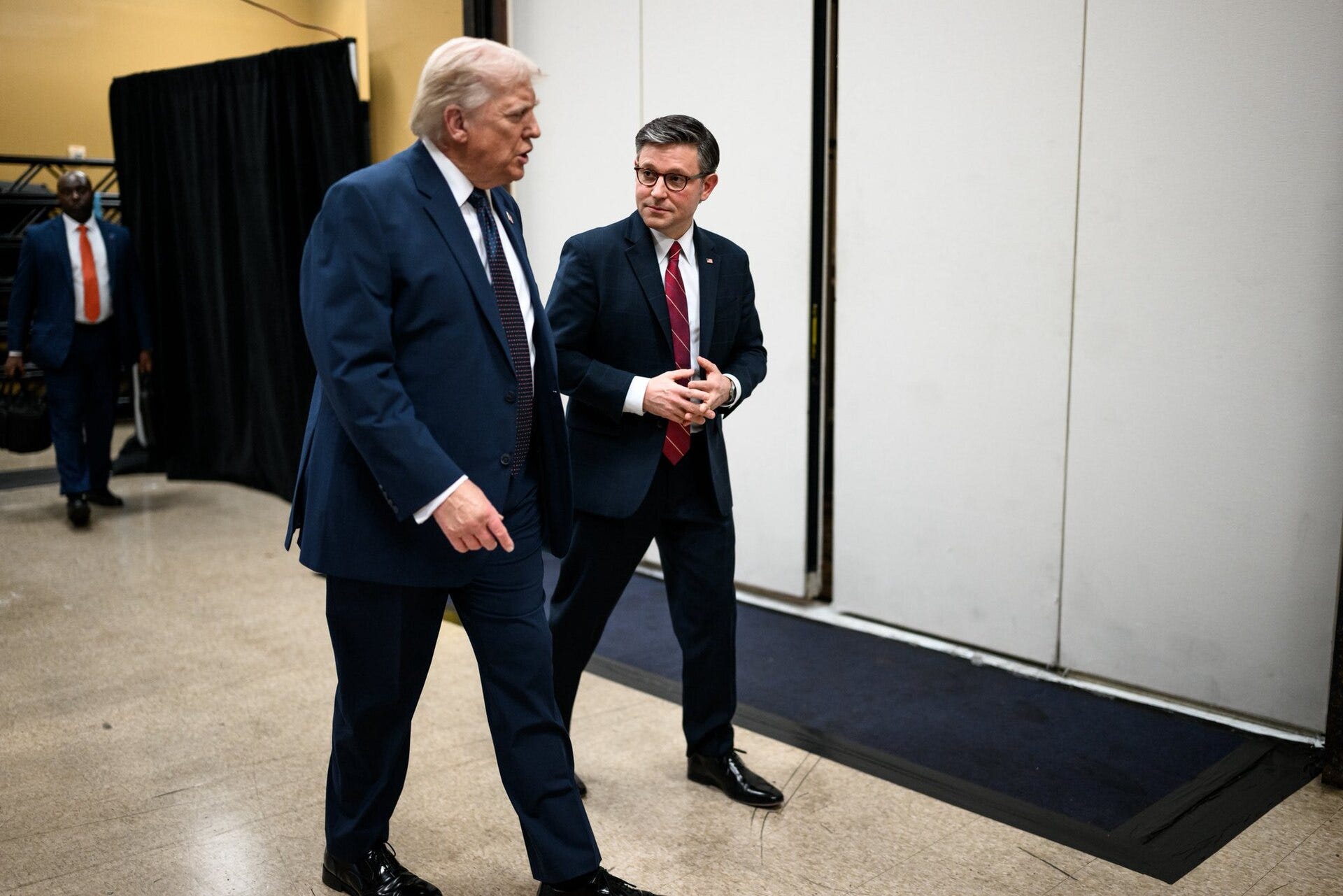
Congress is forfeiting its power. The branch the founders made strongest — the all-important keepers of the power of the purse, of war, of oversight — have handed them, almost gratefully, to the president. Without a hint of irony, House Speaker Mike Johnson (a Constitutional lawyer) has willingly ceded his chamber’s prerogatives to Trump. His party faithful have gazed at the president with adoring, half-lidded eyes and glistening lips as he spends money they never appropriated and wages wars they never approved. All they desire is his approval.
The states have not gone willingly. Over the furious objection of their governors, the president federalized the National Guard and sent troops into Los Angeles, Portland, and Chicago. In a detail Madison would have found beyond belief, Donald Trump ordered one state’s soldiers, Texas’s, into another state, in Illinois! I can’t tell you how many times we sought to redirect, delay, and deny Trump’s illegal efforts in the first term to violate state’s rights and assert his power where it didn’t belong. But that’s why people like me are now under presidential investigation; not because we were wrong (the troop deployments have been ruled to be unconstitutional) but because we cost Trump valuable time.
And what about the courts?
Here the story splits. The lower courts have held. I might go further and say that the lower courts have shown exquisite poise in their defiance of what appears to be — in the eyes of Democratic- and Republican-appointed judges alike — a systemic campaign of criminality carried out by a wannabe despot in the Oval Office. Don’t take my word for it. Read theirs. The rulings have been fiery, damning, and unyielding against transgressions of the law and Constitution.
But their orders have been appealed, ignored, or met with threats to invoke emergency powers to sidestep judicial review. The highest court in the land, which might have held the line, has been moving it — in what appears to be a desperate effort to avoid confrontation with the Executive Branch. In Part I, I told you the Supreme Court placed the president above criminal law. This week, on the eve of our 250th, it went further, handing him the power to fire at will the heads of the independent agencies built to sit beyond his reach.
“The result,” Justice Sotomayor warned in her dissent, “is a President who emerges with far greater power than ever before.” One of judges concurring with the majority, Neil Gorsuch, wrote about it like it was an administrative correction, saying the sweeping powers had been “reassigned to the President.”
I marvel at the pride that must belong to whoever actually wrote the words “reassigned to the President.” So many humiliating things have never been said in so few words. The opinion should have said: “Mr. President, you may go ahead and take what isn’t yours. This high Court has no quarrel with a Constitutional robber baron, so long as you are not too unkind to us. Don’t worry about Congress and their prerogatives. They can go pound sand. We will permit you to pick our pockets and clean our clocks, so long as you don’t take our robes, for we are naked underneath them!” For the simplicity of that surrender in such a short phrase, a smug law clerk deserves a high-paying job at a Washington law firm that bent the knee to Trump.
Let me put it another way. The president didn’t need to pry open all the compartmented chambers for the gasses of power to expand into them. The Supreme Court saw him trying to break in with a crowbar. And they said, calmly, “Don’t trouble yourself. We’ll unlock the door for you and look the other way.”
Take a fresh look at the pillars. The first pillar of restraint was blown to bits by Trump. The second pillar of dissent has cracked as he tries to destroy it from within (though the marble is a bit stronger than he suspected). But to compromise the third, the separation of powers, he’s managed to save some energy. It hasn’t required the blunt force of a fascist’s fury. He’s had help deconstructing it — willing accomplices who were supposed to be his institutional opponents — taking it down for him, as if the pillar been placed in democracy’s temple by accident.
So, as we step warily along the promenade these pillars, we can speculate what the building inspectors might say. The constitutional architects would be alarmed. In a random inspection, they’d look at the first three pillars and tell us to leave the premises immediately. No structural engineer could certify this building.
So should we flee? Against your better judgement, I’m going to tell you to remain. Come see the final two pillars. Then decide whether the structure can be saved.
Your friend, in defiance,

IF YOU’RE A MEMBER, YOU CAN READ THE REST OF THE NEWSLETTER BELOW THE LINE. SIGN UP HERE. AND DON’T FORGET TOMORROW’S MONTHLY MEMBERS-ONLY MEETING!
