


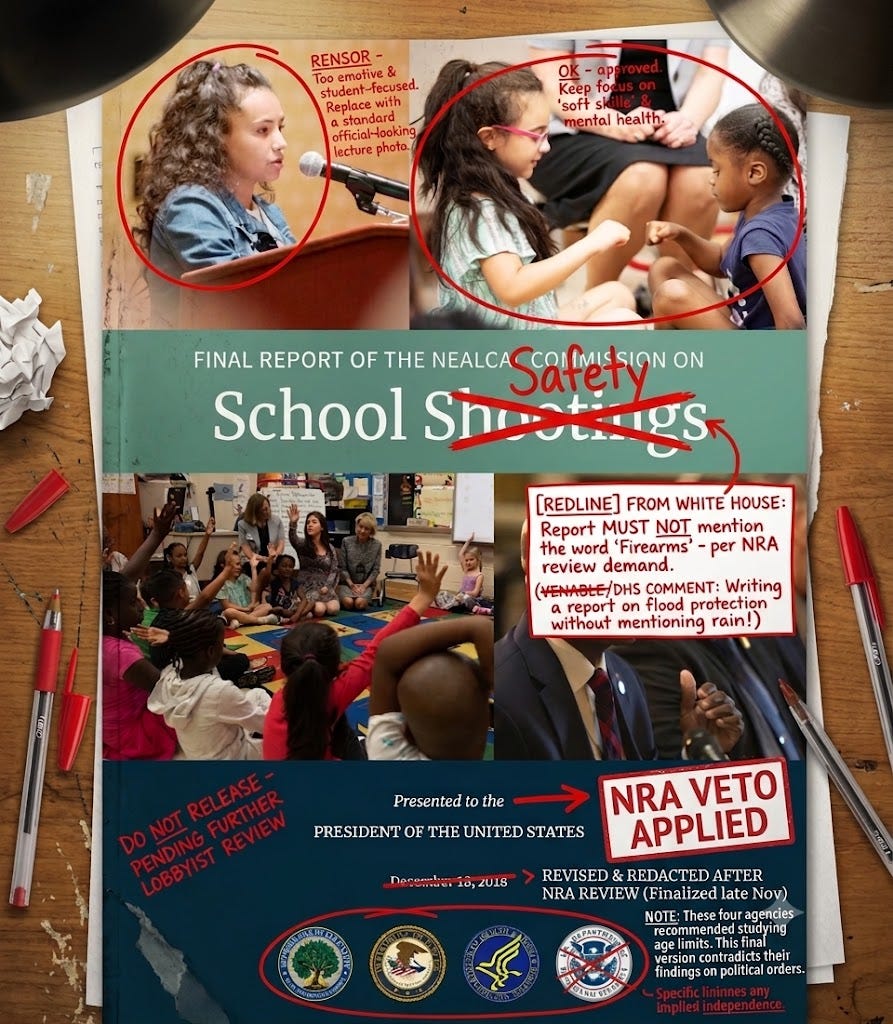
If you doubt that Donald Trump is in the pocket of gun lobbyists, consider this from his first administration: we couldn't release a report on protecting kids from school shootings without first clearing it with the NRA. This week, that fact got a lot more eye-popping.
First of all, I say what I’m about to say as a gun owner. I have a concealed carry permit, I maintain my firearms responsibly, and I believe the Second Amendment is a serious individual right worth defending. So it should tell you something that I’m spooked by what the Trump administration is planning to do. Their changes to federal gun policy, it seems to me, are much more about getting rich than gun rights. And the moves represent the culmination of a tidal shift that began in the first administration.
Let me start with the news here, since you might have missed it over the holiday weekend. In fact, I suspect it was timed for that reason, i.e. to be overlooked.
Trump’s Bureau of Alcohol, Tobacco, Firearms and Explosives (ATF) proposed a rule that would let gun dealers mail guns directly to people’s homes for the first time. This would replace the current system, where online-bought weapons must be routed through a licensed store for an in-person background check. It would be one of the most consequential changes to American gun policy in decades. Indeed, the ATF’s own projection is that nearly 3.3 million buyers a year would eventually order their firearms by mail, like a phone case or a pair of shoes.
And who stands to cash in?
Among others, the president’s eldest son. Donald Trump Jr. sits on the board of GrabAGun, an online retailer that bills itself as the “Amazon of guns,” and he holds a stake in the company. GrabAGun’s chief executive could hardly contain himself, telling investors the firm was “uniquely positioned to capitalize on this potential opportunity.” The company insists Don Jr. had no hand in the rule, and the White House says it has no record of any conversation with him about it.
These assurances (if they were ever worth anything) are worth a lot less in the wake of Trump’s apparent “complaint” that his sons can’t seem to avoid conflicts of interest because it’s just too hard. (“If they buy an energy efficient truck, they have inside information,” he told a CNBC reporter, making the case that his powers as president are so broad that his children, necessarily, are doing business in areas where he’s able to influence the outcome.) And so, whether or not it was done for self-interested purposes, a policy that could enrich the First Family is now sailing through an agency the family controls.
That regulatory change is one of roughly three dozen rollbacks the administration has teed up, from narrowing background checks on some gun sales to loosening restrictions tied to mental illness. Even the ATF itself was worried about the latter proposal. The agency flagged that the mental illness rollback could contribute to mass casualty events, a warning that Acting Attorney General Todd Blanche reportedly dismissed. Meanwhile, the Justice Department’s Civil Rights Division (an office that once spent its days on voting rights and school desegregation) has brought seven lawsuits against states and cities to chip away at their gun-safety laws. Lawyers who spent careers in that division say they’ve never seen anything like it.
Now I’ll tell you why the writing was on the wall. Back in Trump’s first term, I watched him put the gun lobbyists in charge of policymaking, over the objections of public safety professionals and his own appointees.
Let me take you back to Valentine’s Day 2018. That’s when a young man walked into Marjory Stoneman Douglas High School in Parkland, Florida, with a rifle and murdered seventeen students and staff. The country was raw in the aftermath. Parents were writing to Washington by the thousands demanding action, and the White House needed to show it was doing something. So it created a Federal Commission on School Safety and divided the work among four departments: Education, Health and Human Services, Justice, and — my old shop — the Department of Homeland Security.
The man who took the reins was a colleague of mine named Josh Venable, who was then a Trump appointee and Education Secretary Betsy DeVos’s chief of staff. To some in Trump’s orbit, the Commission was just a box to check, basically a way to look busy on gun safety in order to buy time and stave off criticism. To Josh, I remember, it was the most important assignment he’d been given, though he wasn’t necessarily bullish on the prospects of success.
“It was set up for disaster from the get-go,” he told me later. And he was right, though not for the reasons either of us would’ve guessed.
For months, Josh did the unglamorous work of dragging four rival bureaucracies toward a single document. It was supposed to be a report chock full of real, actionable recommendations for preventing massacres in our schools. It can be hard to get factions within a single agency to agree on anything, let alone four different federal departments. But against long odds, he succeeded. All four agencies signed off on a set of recommendations for making classrooms safer and stopping the next Parkland.
That’s when the trouble started.
The draft contained a seemingly modest suggestion. The authors said that the government should study — just study — whether the minimum age to buy a firearm should be raised to twenty-one, the same as the drinking age. To be clear, it didn’t recommend actually raising it. It recommended taking a look at the data. But as we later found out, Trump was terrified of losing the support of the NRA, an organization that would bristle at the mere mention of the subject. So White House staff demanded the gun lobby be allowed to review the report before it went public.
Then, they went further. Word came down from the West Wing that the report should not use the word “firearms” at all. Think about that for just a moment. This was a document commissioned because a gunman had slaughtered children in a school, and the White House wanted the guns edited out of it altogether. It was, as Josh and I later joked darkly, like writing a report on flood safety that never mentioned the rain.
My colleague refused to play along. Josh was already frustrated over Trump’s reluctance to meet with the parents of Parkland shooting victims (in one instance, the president had shown up late to a sit-down with the victims’ families, leaving a bad impression); meanwhile, the president showed comparative eagerness to satiate the NRA. Josh didn’t believe gun lobbyists should hold a private veto over a supposedly independent report on mass shootings when the teachers, school chiefs, and mental health professionals who’d contributed were extended no such courtesy.
“If you want me to do that, I’m done,” is how he put it to me.
Education Secretary Betsy DeVos backed him at first. But it didn’t last long. As the pressure climbed, Trump’s education chief apparently began to waver. And when the president personally intervened to insist the NRA get its say, Josh says that she folded. So he resigned.
He was long gone by the time the commission released its findings, which underwent a series of rewrites in his absence. Unsurprisingly, the final report reached the conclusion the gun lobbyists had wanted. Existing research, the report declared, “does not demonstrate that laws imposing a minimum age for firearms purchases have a measurable impact on reducing homicides, suicides, or unintentional deaths.” That was the opposite of what the government’s own experts had advised. (The Parkland shooter, for the record, was under twenty-one and had bought his rifle legally.)
I remember the day that report landed, because I was supposed to brief Trump on part of that report in the Oval Office. My job was to tell him how DHS could help harden school buildings against attacks. As always, he was distracted. He spent the meeting shifting the conversation back to the border wall (“I want it to be a work of art,” he mused at one point)… whether it could be painted black to burn the hands of anyone who touched it (“How much would that cost?” he asked)… if Congress would fund it (“If they don’t give me the money, we shut the whole fucking border,” he fumed)… and whether there were ways to put more pressure on Mexico to pay for it (“Let’s stick it to the Mexicans!” he declared).
Meanwhile, someone else was waiting down the hall. The parents of school-shooting victims were at the White House to meet with the president. Once again, he was late. Delaying something he didn’t want to do.
Looking back, it seems that none of this was ever really about guns, or the Second Amendment, or even protecting kids. It was about who held the most leverage over Donald Trump in a given moment. In 2018, that was the NRA. In 2026, it’s a gun industry that’s figured out they can go much further with Trump in a second term. The real prize isn’t blocking safety recommendations or regulations; it’s going on offense by expanding the profit-making possibilities, from shipping firearms straight to American mailboxes and hollowing out background checks.
You don’t have to be a Second Amendment critic to find this alarming. I’m not. Personally, I think responsible gun ownership and sensible public safety were never enemies. Most gun owners I know support background checks and think keeping firearms out of the hands of people in acute crisis is just plain common sense, not some kind of evil “confiscation” of personal rights. In fact, most Americans writ large agree with those perspectives when asked in surveys.
You’ll see the results soon. Trump’s gun-selling bonanza isn’t about upholding the Constitution. To any sensible observer, you can see it’s about cashing in. After future mass shootings, we’ll be able to ask ourselves more honestly: at what cost?
Gun owners should be the first to express concern. Public policy made behind closed doors like this — with lobbyists hand-editing government reports and cheering on changes that will enrich the president’s family — can be corrupted in both directions. The Second Amendment isn’t for sale. Yet another president could come in and erase all of these changes and upend markets and suddenly cause folks to be in possession of firearms that are later deemed illegal. Every time a new president comes in, we shouldn’t have a “different” Second Amendment.
The pendulum swings are getting wilder. And right now, the inertia isn’t in favor of life and safety. It’s in favor of making a buck.
Your friend, in defiance,

IF YOU’RE A MEMBER, YOU CAN READ THE REST OF THE NEWSLETTER BELOW THE LINE. IF NOT, SIGN UP HERE!
