


I’m fed up with the Trump administration’s incompetence, so I’m just going to tell you what they should be telling you.
America is walking into a period of technological instability unlike anything we’ve lived through. This is a fact. The people in charge are telling you to shrug it off. You should not.
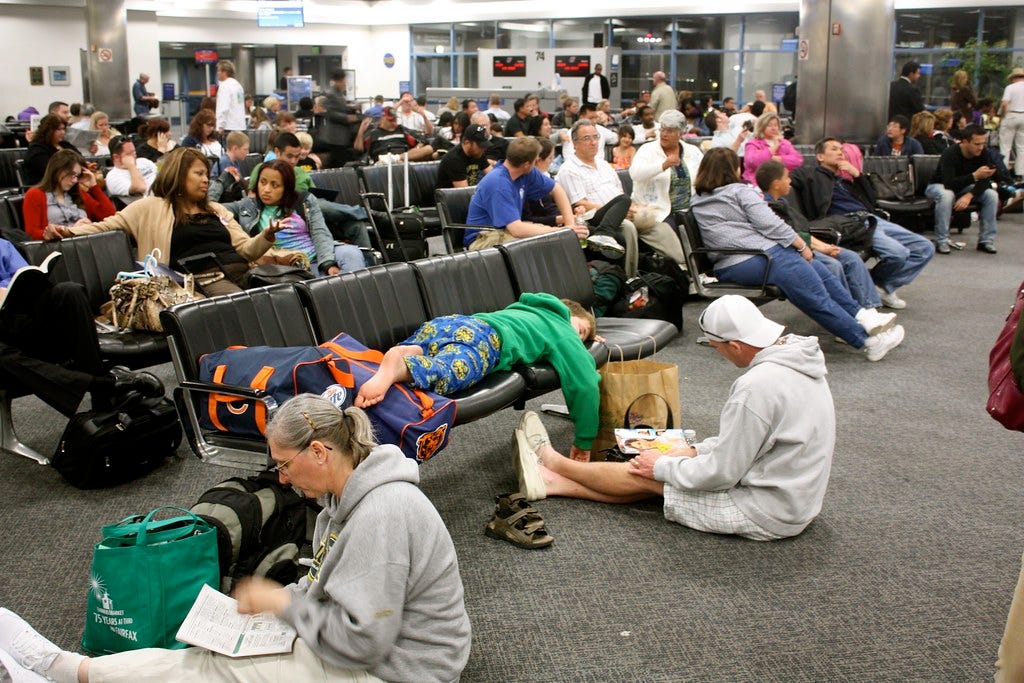
When asked about the outages across email, air travel, banking, and even classified U.S. intelligence networks, the president said: “It’s life. It’s fine.” His secretary of state insists there’s “zero evidence” of an attack. His homeland security secretary, whose advice to the country was “Well, breathe,” flew a government plane to a football game while travelers were stranded (then spent his opening statement to Congress this morning defending the trip).
You don’t trust the slop coming out of the White House, and neither do I. I was chief of staff at DHS. Here’s the straight talk I think they should be giving you:
First, it’s true that there’s no public evidence tying all of these outages to a nefarious hacker. The companies and agencies involved blame bad updates and aging equipment. I have nothing that contradicts them directly and nothing that would suggest we’re under some sweeping cyber assault by one of our foreign enemies.
But that’s not very reassuring. If these were all accidents from fragile systems, you can only imagine what happens when someone tries to take them down deliberately. And bad actors have at their disposal today offensive cyber capabilities like we’ve never seen. What’s more, the idea of the “nefarious hacker” may already be outdated, as we face a surging risk of AI agents acting on their own — not necessarily controlled by nation-state or criminal groups who can be held accountable.
So what’s happening now is a preview of what could become a new normal.
Five days ago, the FBI warned that an AI hacking tool called ARTEX has been turned on banks, hospitals, energy companies, and government agencies since August, with some break-ins going from what we’d call “first contact” to “deep access” in under three hours. From a cybersecurity standpoint, that’s head-spinningly bad. Experts report that serious software flaws are being found at triple last year’s pace and exploited before network defenders even have fixes for them. As I write this, we’re entering a period of cyber vulnerabilities that increase the threats to everything in our digital lives. Everything.
And this is what the Trump administration is scared to tell you truthfully: the federal government is unprepared to respond. The agency built for this moment (CISA, the DHS cyber defense agency that I wrote about yesterday) has lost about a third of its workforce and most of its senior experts, and it’s had no confirmed director this entire presidential term. That’s two years of the fastest developments in the history of technology… met by a rudderless cyber defense agency.
What does this mean? Candidly, it means that in a serious, multi-sector attack against our critical systems around the country, federal help will be thin… and it will be slow… and it will be unreliable. At best. Most of the load will fall on states, the companies themselves, and you.
Yes, you, ordinary American out there. You should prepare the way you would for a very bad storm season, you should do it calmly, and you should do it this week. (Another time, I’ll talk to you about how I think you need to be preparing for the longer term, especially if we witness true “loss of control” of AI. But for now, let’s focus on the immediate of what you need to be doing to be ready for rolling outages of essential services.)
This is what I’ve done at my own house.
Get cash. Make sure you have enough money (and enough small bills) for at least a week of groceries and gas. Don’t count on credit and debit cards and tap-to-pay and ATMs working if things get bumpy.
Keep backup water and food. Yes, you’re a “prepper” now, and don’t be ashamed of it. You need at least a gallon of water per person per day in your household and shelf-stable food for several days at the bare minimum, two weeks if you can.
Stock up on medicine and baby supplies. This one gets forgotten by folks. Have an extra refill at CVS or Walgreens? I’m telling you to go get it. Refill prescriptions as early as your plan allows. Also, if you have littles, obviously keep extra diapers, formula, and pet food.
Secure your papers. Keep a safe place to put printed IDs, insurance cards, prescriptions, recent bank and retirement statements, and the phone numbers you no longer know by heart. Don’t count on what’s in your cell phone to be accessible.
Prepare backups. I’d take an hour or two this weekend to copy your photos and files to a hard drive that stays unplugged. You can pick up a simple external hard drive at any Walmart or Best Buy and drag-and-drop your files onto it, unplug it, and put it somewhere safe.
Have a power plan. Again, like storm preparedness, make sure you’ve got what you need to manage power outages — flashlights, extra batteries, and charged power banks. Go on Amazon right now (yeah, yeah, I know you don’t like Jeff Bezos but I’m trying to make this easy for you) and get a couple of power banks to be able to charge essential devices. Also, always keep your car above half a tank.
Buy yourself a radio. This one may sound boring to the techies out there, but if things go down, you’re going to want this as a backup. A battery or hand-crank radio works when the phone network doesn’t, and it might be how you get essential information. Some of the hand-crank radios out there also double as little power-charging stations for your devices.
Don’t forget the rest of your family. I hope this is already obvious. But if not, make sure they’re going through this checklist, too. And decide where you meet and who gets the kids if phones are down.
Put your digital shields up. Now is the time to update your devices to the latest software, turn on two-step login for everything (preferably passkeys that use your face /fingerprint, rather than texted phone codes). Also, call/contact all three credit bureaus (Equifax, TransUnion, Experian) and put a freeze on your credit. It might be a pain the next time you try to open a new credit card, but it’ll keep criminals from opening accounts in your name.
Stay in touch with your neighbors. Even if you don’t like them. Even if you have different politics. When things go down, your immediate community is your first line of defense. It ain’t gonna be the Trump administration. So know who’s nearby, elderly, alone, or reliant on powered medical equipment. Trade phone numbers on paper.
All of this is doable in a weekend of errands. And I’d advise you not to put it off for some future weekend. In an emergency, doing the above buys you and your family a little bit of cushion and frees up first responders for the people who need them most.
There will be some hard days ahead. The White House is afraid to tell you that because it makes them look bad for leaving us so unprepared (they do look bad, they did leave us unprepared, but they should fess up and do their jobs). As AI-enabled cyber attacks ramp up, some mornings your favorite app might not open, your flight will be delayed, or the pharmacy won’t be able to fill the order. That’s guaranteed to happen. It’s the extended blackout scenarios our public officials need to be scrambling to guard against.
Even then, we’ll get through it. And we’ll get through it resolutely if we stop pretending everything “is fine,” as the president says. No, everything is not fine. AI companies were allowed to race ahead of anyone’s ability to secure what they built, and this administration buried its head in the sand. But the silver lining of the past week is that the American people have awoken to the vulnerabilities and the coming disruptions, and we have a chance to prepare for them thoughtfully. Preparedness has no party. It will take every level of government, every company, and every household.
This is what the Trump administration should’ve told you. Now I’m telling you. So let’s get to work.
Your friend, in defiance,

WHAT’S COMING UP AT DEFIANCE
TONIGHT: DEFIANCE DAILY — Join us every weeknight @ 5pm ET for DEFIANCE Daily (one of the top 10 news podcasts in America!) on our DEFIANCE.News page, YouTube, or X — or listen to the replay, including on Apple Podcasts, Spotify, or wherever you get your podcasts. If you missed our last episode, catch it here:
FRIDAY: WEEKLY COFFEE — Come one, come all! But only DEFIANCE.org Members can ask questions. This is where Xander and Miles let their hair down. No question is off limits. We go LIVE @ 2pm ET on www.DEFIANCE.News and post the video afterwards.
ADD US TO YOUR CALENDAR — You can access the DEFIANCE.org Google Calendar here. That way, you’ll never miss a meeting, event, or broadcast.
DEFIANCE.ORG IS A NON-PROFIT “CLUB FOR THE COURAGEOUS.”
We literally exist to FIGHT the corruption you just read about. We announce a new effort every single week to counter Trump’s abuses of power.
BECOME A DEFIANCE.ORG MEMBER FOR THE FULL EXPERIENCE.
Fund the fight. Your donation goes straight to REAL actions to defend democracy and get justice.
Get inside the room. Join weekly coffees with me, the monthly members’ meeting, and VIP events and announcements.
Get access to the Ant Hill. This is the members-only section of the newsletter: what we’re seeing before it’s public, and what’s coming next.
CLICK HERE TO BECOME A DEFIANCE MEMBER TODAY!

THE ANT HILL IS OUR MEMBERS-ONLY SECTION OF THE NEWSLETTER, BELOW. IF YOU’RE ALREADY A DEFIANCE MEMBER, THEN KEEP SCROLLING DOWN. IF NOT, SIGN UP HERE, SO YOU DON’T MISS WHAT’S BELOW!
