


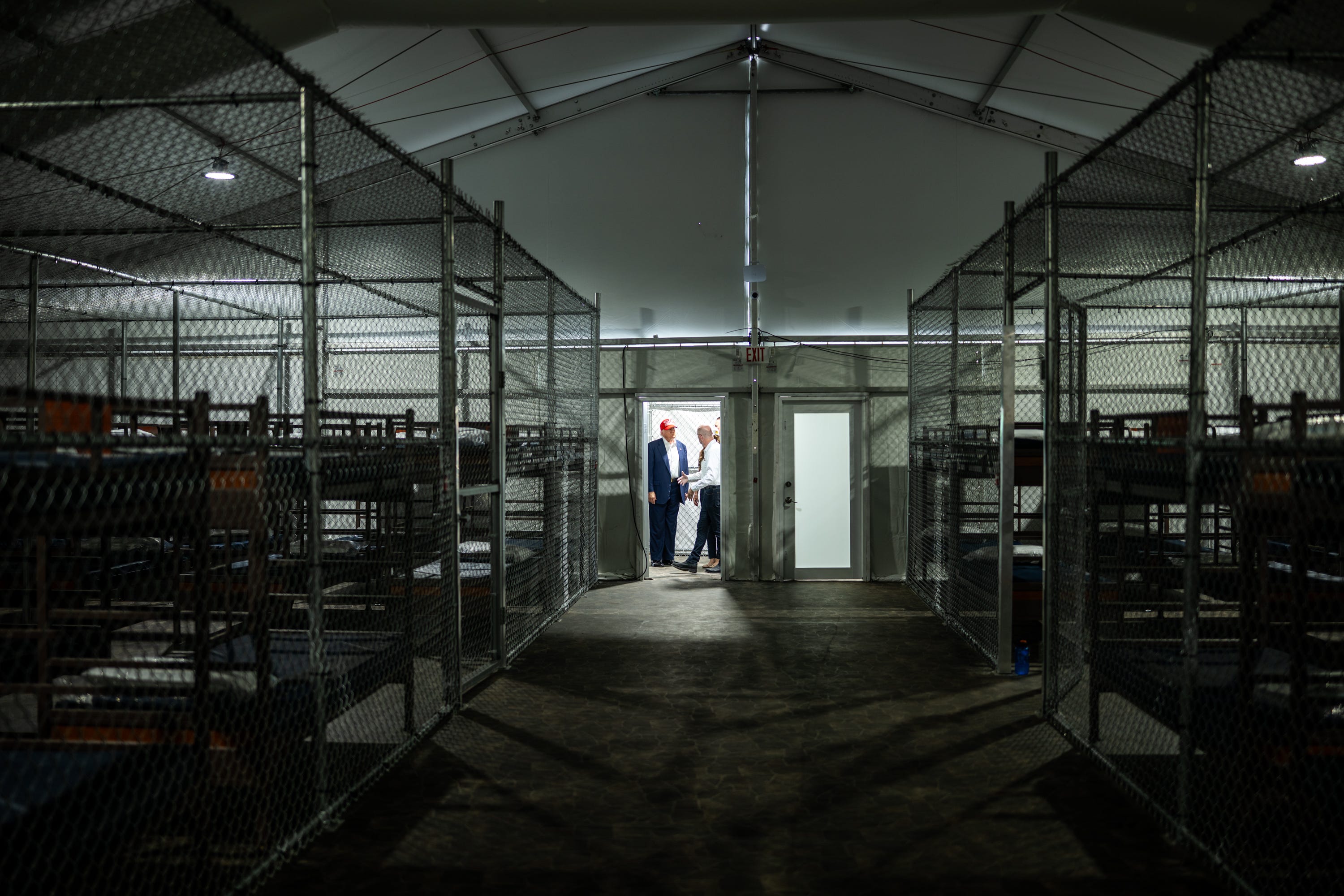
Today, Senator Markwayne Mullin sat before the Senate Homeland Security Committee to audition for the job of Secretary of Homeland Security and refused to put a stop to a Trump administration plan to install secret prisons in American towns.
Senator Maggie Hassan pressed Mullin on whether he would commit to ensuring ICE does not open new detention facilities without the support of local communities — many of which have already been caught off guard by the agency’s attempt to discreetly retrofit warehouses into prisons in towns across America. Hassan had previously pushed hard for DHS to cancel a planned facility in Merrimack, New Hampshire. After sustained public pressure, DHS backed down, but she’s not alone.
Senators from both parties expressed concern about the expansion of the secret prisons effort. But Mullin declined to make any firm commitments. In fact, he punted the question by saying he needed to get into the job first to understand the specifics. It was the type of non-answer that was at once revealing and concerning.
Mullin doesn’t need to be confirmed to the job to know what’s happening, especially when his fellow senators have been shouting to the rafters about it. The controversy has exploded onto the national stage. His refusal to even commit to a more transparent process tells us what we need to know, which is that he appears poised to fulfill the president’s wishes.
At Donald Trump’s direction, what is being built is more than run-of-the-mill immigration centers but, in the wrong hands, the physical infrastructure of a police state.
The president has long harbored an unusual personal obsession with detention — one that reveals how he thinks about power. When I was helping run DHS in the first term, Trump proposed creating alligator and snake-filled pits at the border as an almost medieval way to catch and detain migrants trying to enter the United States. We, of course, declined. He repeatedly raised the idea of expanding the terrorist prison in Guantanamo Bay, Cuba, alarming officials who feared his real desire was a facility beyond the reach of U.S. courts — somewhere to send not just terrorists, but anyone he deemed an enemy. And he openly mused about reopening the notorious Alcatraz prison.
In the second term, these eerie ideas have gone from fantasy to fact, with aides all-to-willing to bring the president’s perverse ideas to life. Trump opened “Alligator Alcatraz” in the Florida Everglades and visited it for the cameras, urging other states to follow suit by using the threat of reptilian death to deter migrants. He directed the Pentagon and DHS to build a sweeping Migrant Operations Center at Guantanamo to hold up to 30,000 people, despite the extraordinary cost and warnings about the illegality of using the facility for such purposes. Meanwhile, the Justice Department has made moves to re-open Alcatraz, even though officials see the island prison as an entirely unnecessary accessory for the U.S. criminal justice system.
These were just the visible tip of Trump’s plan. In the meantime, something far larger has been planned in the shadows and is now underway.
DHS is executing a $38.3 billion “Detention Reengineering Initiative,” a plan to construct a nationwide network of sites where they can detain their targets, ostensibly illegal immigrants. The model calls for eight large-scale detention centers, sixteen processing sites, and ten additional facilities, with the large-scale centers designed to hold seven thousand to ten thousand detainees at a time. With funding already locked in, DHS is on track to operate upward of 135,000 detention beds through the end of Trump’s second term.
The DHS detention network would rival the entire federal criminal prison system. And the communities where these facilities are being planned have been, in many cases, caught totally by surprise. That seems to be by design.
In Social Circle, Georgia (a town of 5,400 people) city officials first learned of plans to convert a million-square-foot warehouse into a detention center for up to 10,000 migrants from a Washington Post story on Christmas Eve. The facility sits less than a mile from a new elementary school. This week, the city manager cut off water to the warehouse, demanding DHS explain how the facility’s needs can be met without crushing the town’s infrastructure. There’s a reason the administration keeps these facilities secret for as long as possible. That’s because transparency invites accountability, and accountability is precisely what this program appears designed to avoid.
I worry a great deal about our lawless president having personal command over a secret prison network. During the first Trump administration, I witnessed firsthand how the White House inserted itself into our operations and how political appointees tried to personally direct agency activities and use DHS for political purposes. The second term has taken all of that and accelerated it, with far less institutional resistance remaining.
DHS’s constitutional violations under Trump are already well documented, from the illegal arrest and surveillance of American citizens to retaliation against First Amendment protected speech. They’ve tried to keep other systemic violations under wraps. For instance, a confidential ICE memo, recently revealed by whistleblowers, authorized agents to forcibly enter homes using only administrative warrants, rather than judicial warrants signed by a judge. The memo was rolled out covertly, with agents verbally briefed and told to return their copies, reportedly under threat of termination if they objected. DHS’s own training materials had previously called warrantless home entry the “chief evil against which the wording of the Fourth Amendment is directed.”
Now pair all of this with the architecture Trump has built to go after the political opposition in this country under the guise of “national security.” In September 2025, the president issued NSPM-7 — an order listing ideological characteristics as terrorism indicators to be investigated by federal authorities, including “anti-Americanism, anti-capitalism, and anti-Christianity” — effectively targeting views held by millions of ordinary Americans. Anyone who thought this was merely performative was disabused of that notion in January, when DHS agents killed two American citizens in Minneapolis and rushed to accuse those protesters of being “domestic terrorists.” And it doesn’t stop in Minnesota. NSPM-7 directs all 56 Joint Terrorism Task Forces across America to investigate and prosecute individuals with these views who are alleged to have ties to political violence, a definition broad enough to encompass labor organizers, anti-ICE protesters, and racial justice activists.
Now do you see the full picture?
The administration is systematically violating the constitutional rights of Americans… they’re going after political opponents as “terrorists”… and they’re now putting together a shadowy, expanding detention network within DHS, the department that Donald Trump micromanages more than any other. Add to this the fact that Trump continues to demand the arrest and imprisonment of his rivals, and you end up with a pretty alarming picture.
As I noted earlier, in the wrong hands, this would be the physical infrastructure of a police state. And we can say with confidence that it is in the wrong hands.
Senator Markwayne Mullin will almost certainly be confirmed as DHS secretary in the coming weeks. Today, it sounded like he is willing to finish what Kristi Noem started for Donald Trump — or at least unwilling to resist it. His non-answer to Senator Hassan’s question about the DHS prisons was the most honest thing he said today. If he does nothing and allows these facilities to proceed, he will have effectively accepted his role as the “warden” of Trump’s would-be police state.
But there’s good news.
A counterforce is growing against these detention centers. In Hanover, Virginia, citizens fought off one of these facilities last month. In Merrimack, New Hampshire, residents spoke up and won. In Social Circle, Georgia, they just cut off the water to one of the warehouses. And tonight, DEFIANCE.org will announce yet another community joining that fight, where we will shine a spotlight on for weeks to come.
Join us at 5pm E.T. for the announcement.
Donald Trump can try to build his network of prisons. But he cannot build them without the communities in which they sit, and Americans of both parties, in red towns and blue, are making clear that they will put up a fight.
Your friend, in defiance,

That people can’t see the similarities to Nazi Germany amazes me. I certainly won’t be surprised to see activists locked up.
It is up to the communities, counties, and states to fight these detention centers in whatever ways are possible. It’s going to be expensive and dangerous. They will take away already appropriated funding and threaten people. We also know how violent they can get. We have seen it in real time. They are vicious and full of hate. But Minneapolis was our training.