


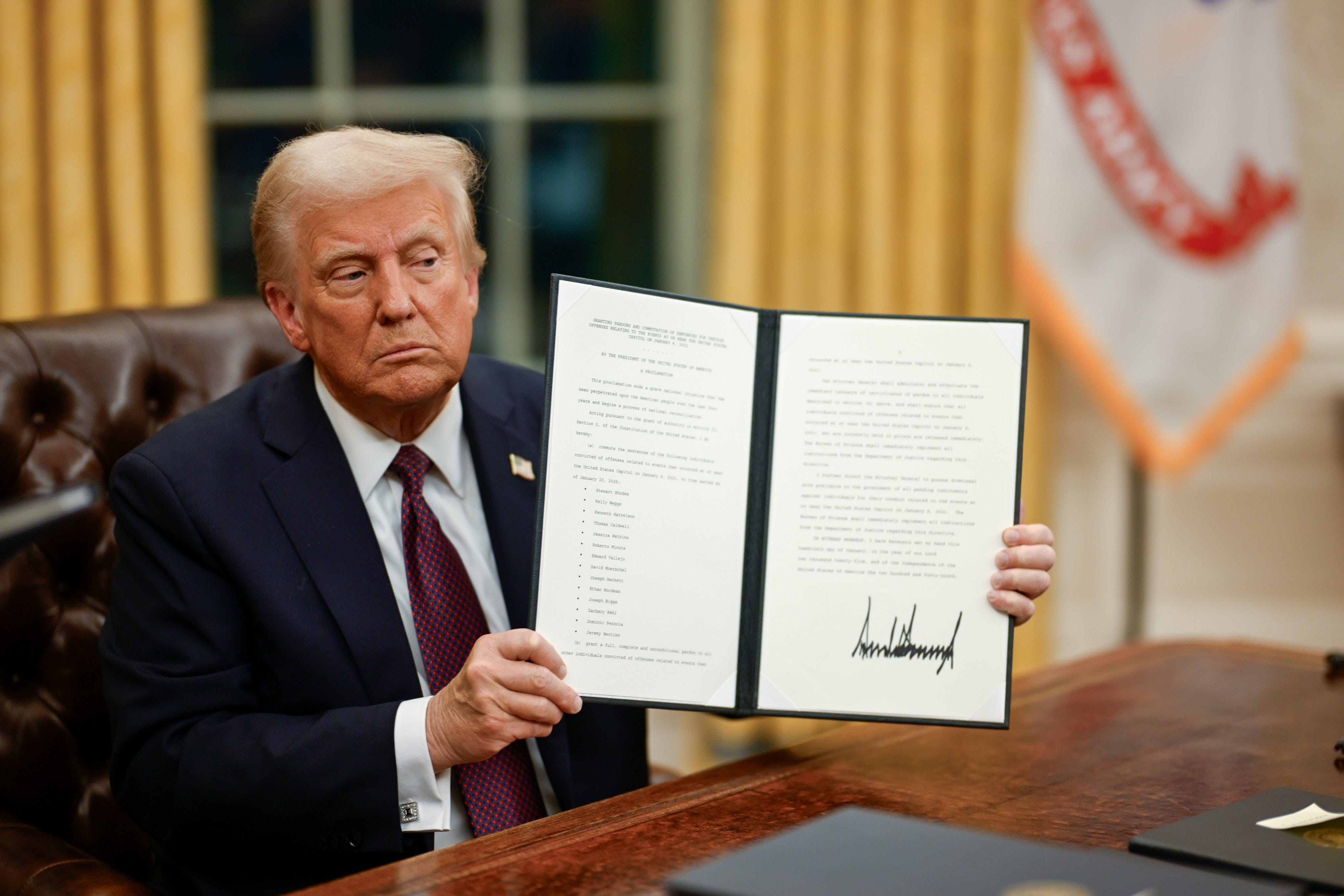
In Donald Trump’s second term, something extraordinary is happening. Without an amendment to the Constitution, he has invented something new. I call it the “super pardon.”
A Bloomberg report out this week dives into Trump’s latest corrupt feat, revealing how he’s become the first president in modern times to issue pardons for companies. If you’re baffled, you should be, but it’s even more alarming than you think because Trump’s not simply forgiving corporate crimes. He’s giving companies what amounts to a hall-pass to carry out misconduct in the future. I’ll get to that in a moment.
Let’s start with the plain fact that he’s doling out pardons for corporate malfeasance.
The freshest example landed just days ago. Ryan LaLone, a Michigan diesel shop owner convicted of tampering with emissions systems, received a presidential pardon and so did his actual business, Diesel Freak LLC. With the stroke of the pen, Trump erased a $750,000 penalty that LaLone and his company were facing, after the man became a cause célèbre in MAGA world for being a purported victim of Biden-era overreach (LaLone was charged with deleting controls on vehicles that were meant to stem emissions). Now both the man and the LLC have been absolved.
It’s important to take a beat to understand how radical this is. For the 239 years since the Constitution was ratified, the pardon has typically been understood as an act of mercy for individuals. Presidents grant clemency to people who committed crimes but are seen as deserving a reprieve, whether because their sentences were unusually harsh or their convictions were unjust. The founders saw the power as a safety valve to temper the severity of the law and, on occasion, restore domestic tranquility. They didn’t envision it as a magic wand to be waved over entire corporations, i.e. legal fictions that cannot sit in a jail cell, cannot be executed, and cannot, in any meaningful sense, be shown “mercy.”
The precedent-shattering case came last year with a company called BitMEX, the crypto trading platform that pleaded guilty to flouting anti-money-laundering laws. When Trump took office, he axed the Biden-era crackdown on unregistered crypto exchanges, and BitMEX found itself with friends in the highest of places. The company wasted no time in currying favor, launching a swap listing tied to the $TRUMP memecoin (a business venture that personally earned the president $636 million last year), while cofounder Arthur Hayes penned a fawning essay celebrating Trump’s embrace of meme coins. Weeks later, on March 27, 2025, Trump signed pardons for Arthur Hayes and three other former executives of the BitMEX crypto exchange. Then, in a first, he pardoned the company itself the very same week its $100 million fine came due.
Since then, Trump has extended clemency to nine companies and counting. As Bloomberg reports, the president has been wielding the pardon power in ways akin to a king granting favors to feudal landowners. His fortunate subjects span industries, from an auto supplier to a media startup to a crypto platform. In the process, almost $200 million in financial penalties (some of it intended for victims of wrongdoing) has been wiped out.
He’s not the first president to have flirted with the idea, to be clear. Jimmy Carter confronted the question in 1977, when a mob-connected company sought a pardon. In the end, he declined. Every president before and after him left the line pretty much uncrossed, though many famous corporate executives themselves have received presidential mercy. But Trump has discovered that forgiving companies themselves is, apparently, a marvelous way to ingratiate himself with them.
True to form, he’s operationalizing the practice. The corporate pardon now works like a well-oiled machine, less than two years into the second Trump administration. And the opportunities for corruption are seemingly limitless.
Frank Bowman, a professor at the University of Missouri School of Law, put it this way:
“In any previous era no president would touch this with a barge pole. Maybe individual cases with some compelling reason, but the systemic elimination of criminal liability of major financial crime would never have happened before, and it didn’t.”
Yet the literal presidential pardons are only the visible tip of the scheme. Trump is cobbling together other executive powers to forgive companies and to give them wider latitude with which they can conceivably carry out misconduct in the future. That’s why I call Trump’s newfound powers the “super pardon.”
The full arsenal Trump can use for corporate forgiveness is staggering. He’s realized he can regulate an industry or de-regulate it… he can award federal contracts or yank them away… he can open investigations or quietly close them. Wielded separately, each of these is a routine exercise of executive power. But wielded collectively and transactionally, they amount to something new: again, what I call the “super pardon.” Trump has hacked together a way to make criminal liability, regulatory burdens, and competitive disadvantages all disappear for companies that he favors.
As a consequence, he now holds more raw power over American industry than any recent occupant of the Oval Office and arguably any in history. Not because of any new authorities but because of a novel and corrupt combination of them. Together, those powers open the door to unprecedented pay-to-play schemes.
We’re already seeing it happen. A Public Citizen report found that in the administration’s first year alone, the Justice Department canceled or halted 159 enforcement actions against 166 corporations. At least 18 corporations accused of lawbreaking avoided paying $3.1 billion in penalties for misconduct. Who’s off the hook? Bank of America, Binance, Capital One, Charles River Laboratories International, GE Healthcare, Globe Life, Paypal, Peloton, Pfizer, Polymarket, and Toyota, to name a few. Meanwhile, the Consumer Financial Protection Bureau has dismissed dozens of public enforcement cases. Enforcement of the Corporate Transparency Act has been largely halted. Inspectors General across the government were fired in the administration’s opening days. And over at the FBI, the elite public corruption squad was dismantled, and under Director Kash Patel, federal law enforcement has pivoted away from white-collar and corporate crime altogether. (The administration has even paused criminal enforcement of the law that prohibits U.S. companies from paying bribes to foreign officials! Yes, bribes!)
If you harbor any doubt about whether this administration is granting broad reprieves for reasons that are “above board” or on the “merits,” here’s your warning sign. A cottage industry has already sprung up to profit from it. Lobbyists, lawyers, and self-styled clemency advocates are lining up to bring pardon cases to the president, because they know there’s money to be made at the front of that line. A group of former Trump campaign and administration officials even started their own federal lobbying practice to focus on the pardon business, where millions are being made by bringing the cases to the president’s attention.
And now they know that they can press for more than just a pardon on a piece of paper for a specific crime. While they’re at it, they should also try to bundle in regulatory help, enforcement relief, and maybe even seek a federal contract or two. If they donate to Trump’s ballroom or super PAC, perhaps they’ll get the full super-pardon package.
Let’s dispense with any notion that these acts reflect presidential “generosity.” In Trump’s orbit, I can attest personally, there is no such thing. After all, this is the man whose New York charity was shut down by court order, ordered to pay $2 million in fines for misusing his own foundation’s funds for personal benefit, and who was barred from running charities in the state because even his philanthropy was judged a sham. Everything with Trump is transactional, which means every one of these super pardons raises the same question: What did Trump get, or what will he get, in exchange?
The only solace I have about the president granting what amounts to “super pardons” is that he’s given us a gift. When power changes hands, he’s telling us exactly what to investigate. And he’s left much of it in the public records. Cheers, Mr. President.
Your friend, in defiance,

IF YOU’RE A MEMBER, YOU CAN READ THE REST OF THE NEWSLETTER BELOW THE LINE. IF NOT, SIGN UP HERE!
