


Trump once told us the truth behind his border wall in private. What he really wanted, he said, was soaring black spikes baking in the hot sun — electrified, if possible — and tall enough that the bloodied corpses of attempted climbers might dangle above the desert floor and send a message to others: do not defy me.
It was January 10, 2019.
We were on Air Force One with the president, headed to the Southern Border, and Donald Trump was in a boisterous mood. The U.S. government was partially shut down, and Trump felt like he was winning. Before we took off, we told the president that TSA and FEMA employees were about to miss paychecks. But he assured us Congress would cave.
The goal of his game of chicken? More money for the border wall.
Almost no one in the administration had supported a shut down in December 2018. In fact, we were caught completely off guard when the president — just before the holidays — started musing about not signing an incoming budget bill from Congress. Although the appropriations legislation had been passed unanimously by the Senate, he felt the familiar urge to stun Washington. If he refused to sign, Trump said, he could use it as leverage for House Speaker Paul Ryan to get him funds for a big, beautiful wall.
$5.7 billion, to be exact.
Speaker Ryan said he didn’t have the votes. Trump didn’t believe him. So the president decided to take a gamble. He balked at the budget bill, refused to sign anything without a border-wall windfall, and shuttered much of the government as federal workers prepared to celebrate Christmas with their families.
Government employees panicked. At DHS, emergency responders fretted about whether they could afford presents for their children. Some asked us whether they should squirrel away their final December paychecks, just in case the standoff dragged on and they wouldn’t get paid in the new year. We didn’t know what to say. The president had no game plan, and he brushed off our worries. As it turns out, those who left space under the Christmas tree were right.
By January 10, three weeks into the shutdown, it was no closer to resolution. Trump had done little personal diplomacy with Congress over the holiday. Hundreds of thousands of employees were now on the cusp of missing payroll. And Trump was in no rush to reopen the government. He was in good spirits and confident his gambit would pay off.
In fact, he wanted to take a trip to the border — to visualize what the billions in hoped-for cash could buy him at the border.
I climbed the steps onto Air Force One that morning armed with charts about the DHS budget and the operational toll of the shutdown, from counterterrorism to disaster response. Airports could soon be thrown into chaos if TSA agents started to call out of work. The human toll would fast become apparent, too. Our employees wouldn’t be able to pay their rent or mortgages. If Trump didn’t broker a deal, federal workers would start showing up at food banks.
Alas, those were not the charts the president wanted to see. I was summoned to the his cabin for another reason.
Trump had come up with an idea. He assumed he’d get the billions in taxpayer dollars he wanted, and he was busy mentally designing a bolder, bigger border wall. Not the boring, corrugated metal panels that CBP put up. He wanted to make his mark. He’d been toying with concepts to scare away asylum seekers. Once we were in the air, the president conveyed the most important feature. The border wall needed something iconic, he said: a mechanism to pierce the living flesh of anyone who scaled it.
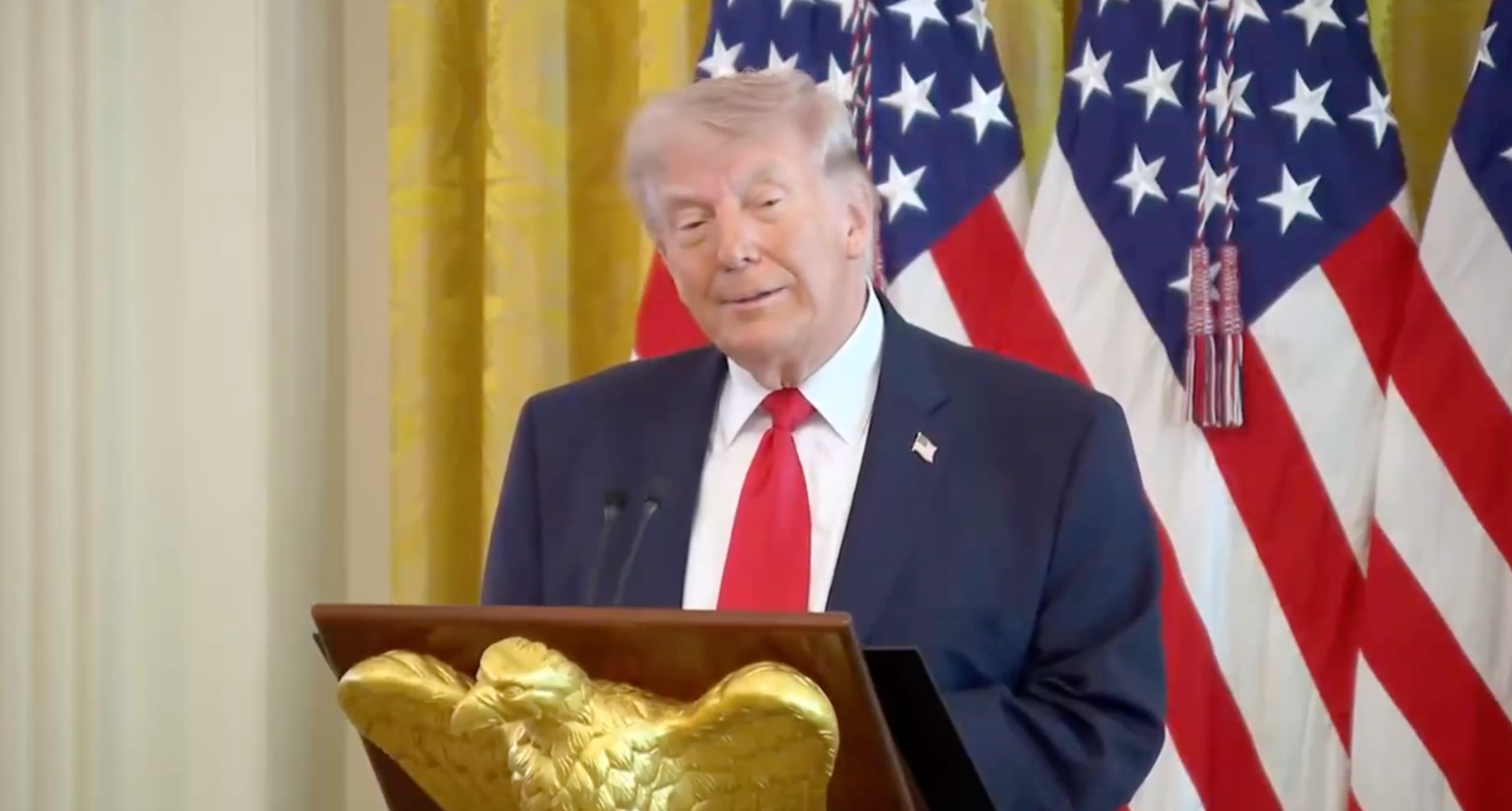
At a White House event earlier this week, President Trump hosted a closed-door Easter lunch in the East Room. The guest list included select MAGA allies and faith leaders, as well as Secretaries Rubio, Hegseth, and the soon-to-be fired Pam Bondi. The event was supposed to stay private, but the White House mistakenly posted the video to its official website and YouTube channel.
Perhaps most notably, Trump’s “spiritual adviser” Paula White-Cain, who heads the White House Faith Office, took the stage at the event and addressed Trump directly.
“Mr. President, no one has paid the price like you have paid the price. It almost cost you your life. You were betrayed and arrested and falsely accused. It’s a familiar pattern that our Lord and Savior showed us. But it didn’t end there for him, and it didn’t end there for you.” She then connected the resurrection to Trump’s political comeback, telling him: “Because of His resurrection, you rose up. Because He was victorious, you were victorious.”
Trump stood stone-faced and bored as White began her remarks about Jesus. He is not, after all, a reader of the Bible — or a regular reader of books of any sort, for that matter. But he perked up the moment she pivoted to comparing him to the Savior. His expression shifted into a wide smirk, and he raised his eyebrows and mouthed a quiet “thank you.”
He welcomed comparisons of himself to Jesus Christ. In fact, the president had already set the tone before White spoke. Referencing Palm Sunday — when crowds welcomed Jesus into Jerusalem as the messiah, or king — Trump told the room: “They call me king now, can you believe it?” He then complained that he couldn’t get a $400 million White House ballroom approved, adding with obvious disappointment, “I could be doing a LOT MORE if I was a king.”
The response from faith leaders was swift. Jesuit priest James Martin drew a clear line: “Comparing a political leader, in a public prayer, to the sinless Son of God during Holy Week? No.” Reverend Benjamin Cremer called the remarks “blasphemy,” saying it was “what it sounds like to take Jesus’ name in vain.” Even conservative commentator Erick Erickson blasted the group for “twisting scripture.”
The White House deleted the video from its site and YouTube channel, though a thumbnail briefly remained. Aides refused to respond to press inquiries about why the footage was removed. But the reasons weren’t hard to surmise. The president and his guests had gone too far in their historical comparisons, even for MAGA faithful, by comparing him to Jesus Christ.
But there is an interesting historical comparison to be made between Trump and the contemporaries of Jesus of Nazareth. While the president may bear little resemblance to the Jew who came to be known to many as the Messiah, Trump shares striking similarities to another man of the period. Indeed, a man who the Roman Empire sent to govern the Holy Land during the time of Jesus was similarly known for his kingly conduct, ostentatiousness, and impiety.
As Christians, we’re sometimes taught that this man, Pontius Pilate, was a morally conflicted leader. He governed Judea on behalf of Rome, and during that time, he faced a historic decision. A mob demanded he put to death a controversial preacher from Nazareth. Pilate was so overcome with doubt about putting Jesus to death that he did everything in his power to save his life. Then, he reluctantly caved to those who demanded blood and had Jesus crucified.
But history tells another story, not of Pilate as the hand-wringing man of conscience he’s been made out to be, but as a bloodthirsty tyrant who relished punishment. Rome was even forced to remove him from his post for excessive cruelty.
Two of the most authoritative sources from the period — Philo of Alexandria and Josephus — paint a consistent picture. While attempting to maintain an occupation of the Holy Land on behalf of the Roman Empire, Pilate built a reputation for persecution of his enemies, for public insults and controversies, and for a vengeful agenda. While he tolerated the religious establishment, it was not out of respect but to maintain power. He kept Jewish leaders close to maintain his grip, while often mocking them and inflaming religious sensitivities with his conduct. Indeed, Pilate was derided for elevating false idols, lining the palaces of Jerusalem with gold-plated excess, and expropriating money from the Jews.
But religious leaders depended on him for their own power. So many seemingly endured the humiliation.
What’s most notable about Pilate, in my view, was his nagging political anxiety about forces out to undermine him and Rome. He developed an obsession with insurrection. The rabble-rousers who gathered crowds in protest or claimed allegiance to some other “kingdom” (including the “Kingdom of God”) were charged with sedition. During his ten-year reign, Pilate is said to have carried out hundreds of crucifixions without trial, including preemptive executions of people he suspected were a threat to Roman authority.
The use of the cross was deliberate and calculated. Accused insurrectionists and invaders were nailed up on a hillside as a public warning. Every would-be dissenter or activist in the province could see. In many cases, the flesh of the dead would hang for days in the hot sun to send a message. Do not defy Pilate. Do not defy Rome.
When Jesus of Nazareth entered Jerusalem on Palm Sunday, acclaimed by crowds as a king, he would’ve been on Pilate’s radar rather quickly. A man had entered the territory, openly questioned the authorities, and proffered that there was something greater than the Empire. Indeed, if Christians and scholars agree on anything, it’s that Jesus was put to death for sedition.
That day in January, I sat in Trump’s cabin waiting for him to say something.
As we reached cruising altitude, the president sat watching the television behind my head. It was his own face on the screen. His voice emanating from the speakers. He was consuming a Fox News report on a recent controversy, and judging by his barely hidden grin, he was pleased with the coverage. After a while, he jutted the remote at the television and commanded it to silence.
Then he fixed his gaze. He wanted to see the designs.
In my bag, I’d brought the newest mock-ups of the border wall for Trump. DHS had been in an exhaustive process with the president since he took office. First, he’d wanted a mammoth concrete wall built along the Southern Border. Then he changed his mind and proposed a different design. Something more elegant, he said. Then again, he suggested digging an expansive moat along the border and filling it with deadly reptiles.
Recently, he’d settled on a new aesthetic. He wanted bollards. Tall, steel polls secured closely together. Like prison bars blocking the entrance to the country. Border officials were fine with this, as long as their agents could see people on the other side. They’d disliked his concrete bunker concepts because they wouldn’t know if someone was attempting to get over or not — and his alligator moat because it was absurd.
As the president pored over the papers, his face soured.
“These,” he said, tapping his finger at the top of the wall design, “I don’t like these.”
He was pointing to the curved metal panels, known as an “anti-climb” feature. I reminded him that he told DHS to make the wall harder for people to get over. The panels did exactly that and were in use elsewhere on the border. He had a different idea, he said.
“I want spikes,” Trump declared. “Big spikes.”
In his mind, the wall needed to be more than just formidable. It needed to be lethal. If its height wasn’t enough to kill someone from a fall, he said, the top needed to be sharp enough to do the job. I didn’t need his explanation. Weeks earlier, he’d already asked for a drawing with spikes on the wall. Border officials showed him a simplistic cartoon concept (not an official rendering), and before we knew it, he’d tweeted it out gleefully.
Today, we were showing him something more serious. But he groused that it didn’t look intimidating enough. To him, functionality didn’t matter nearly as much as fear. The wall itself needed to deter anyone who dared to approach it.
His tone grew stern. Did we not realize this was an invasion? There was an invasion at the Southern Border. These were criminals and foreign invaders. They were a threat to America.
What he wanted, he emphasized, was spikes. Atop the steel bollards. They needed to be sharp. Sharp enough to easily pierce human flesh. If they weren’t sharp, there was no point. Also, the wall needed to be painted black, he reminded us. So it would bake in the sun. During their ascent, climbers’ hands should be burned instantly. And, if they managed to reach the top, they should face the possibility of getting impaled on the spikes.
If that wasn't enough, Trump took a moment to describe the gruesomeness of the sight. The blood. The hanging, nameless migrant. Up high on the bollards for anyone to see. For everyone to see, really. That was the point.
“Trust me,” he said. “It’ll send a message.”
The 2018 - 2019 shutdown ended in failure for the White House.
Trump never got the border wall money he wanted, and he delayed designing and re-designing his spikes in order to figure out other ways to get the money. That included declaring a “national emergency” in February 2019 and raiding other agencies’ bank accounts to find cash for construction.
Unable to muster his self-purported dealmaking prowess with Congress, Trump was left without sufficient funds. He only built 52 miles of new wall. Far short of the thousands of miles needed to achieve his vision.
At the time, opponents of Trump’s immigration crackdown felt like they’d beaten him. They were relieved when he left office. But I was relieved for a different reason. I knew that what he wanted wasn’t a wall. It was a weapon. At other points, he suggested to us the wall also needed to be electrified. As if it weren’t enough to burn and stab the migrants, they needed to be shocked, too.
The most frustrating part, of course, was that Trump could have had an immigration deal. There was a pathway to bringing Democrats and Republicans together to achieve the kind of grand bargain that’s eluded other presidents. But he had no interest in that kind of outcome. He wanted to look tough. And his immoral and illegal missives are what first drove me to quit.
While I never heard Donald Trump say he wanted to forcibly impale migrants on the border wall, the possibility of such harm was the point. (He did, however, propose shooting them.) Trump wanted to strike fear into the hearts of the people seeking refuge. Those invaders were to understand that they’d get no safe haven in the United States of America. They’d face death.
This is the character of our current president.
His lexicon is rife with the anachronistic terminology of crime and punishment. He’s a man who posts messages in response to criticism from political opponents such as, “SEDITIOUS BEHAVIOR, punishable by DEATH!” — and opens federal investigations for protected speech, as he did to the Members of Congress who warned federal employees about illegal orders. Trump rants about “insurrection,” “invasion,” “rebellion,” “enemies of the state,” “enemy combatants,” “alien enemies,” “gang monsters,” and so on. He’s remarked ruefully that America no longer hangs its criminals or uses firing squads. And too many times to count, he’s threatened retribution against his foes to set an example.
Some have accused the president of “medieval”-level cruelty. In fact, that’s exactly how one CNN panelist described it when news broke during the first Trump administration that the president was demanding we place those sharp “spikes” atop his border wall. Was the president drawing his inspiration from the “Middle Ages”? the commentator wondered aloud on television.
It was a fair question, but her time horizon was wrong. The Medieval Period (or Middle Ages) was approximately 500 AD to 1500 AD. The time was marked by ruthless leaders who fought over boundaries, fortified territories, and inflicted unspeakable punishments on rivals.
Trump’s visions of civilian harm actually dated further back. Some of the methods that seemed to excite him had roots in Classical Antiquity (800 BC to 500 AD). In the time of Jesus. Because if there’s one way to describe what the president of the United States imagined seeing on his border wall, it was casual crucifixions. He wanted the intruders who challenged his authority to meet a violent end. He wanted others to see. And he wanted all to be cowed.
That’s cruelty, alright — in its oldest form.
Your friend, in defiance,

What an absolute horror for any of you who still maintained a moral compass. Your nightmare was unfolding and history shows what torment he has put you and your family through. Why can't this evil person be stopped? When will the leaders of countries band together announcing that he must stop this war in Iran, or he will be charge with war crimes. Is that possible?
This description … at this time of year … is a sharp reminder (pun intended) of the amorality of this wanna be dictator. A child. But not innocent.