


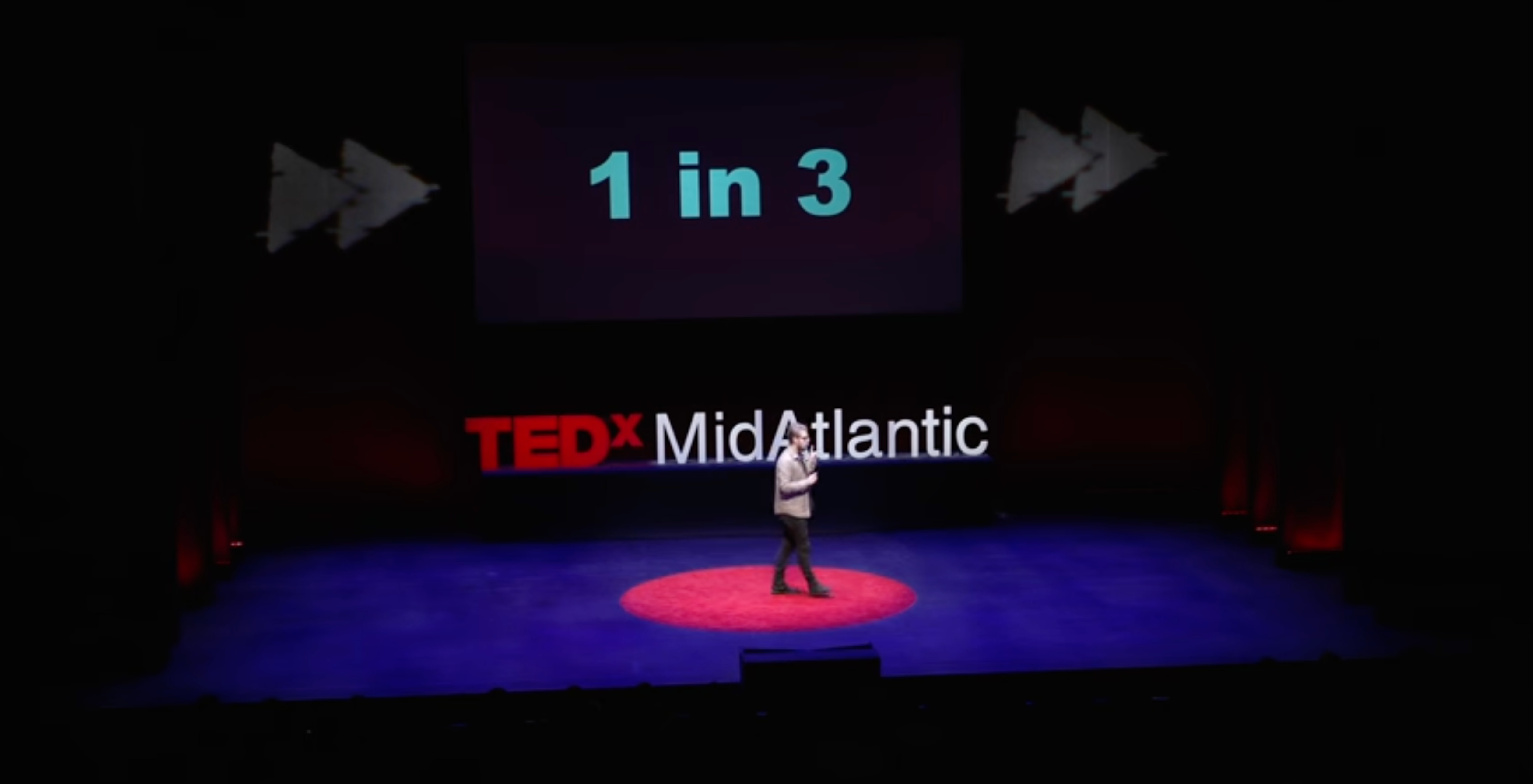
In the United States today, you’re just as likely to own a cat as you are to believe that we might need to kill each other to resolve our differences.
I did a TEDx talk last year on the rising cost of dissent in America.
During that conversation, I brought up a shocking survey that NPR had just released which found that 1 in 3 Americans now believe political violence may be necessary to put the country back on track.
1 in 3.
For perspective, I told the audience that 1 in 3 Americans also own a cat. Consider that for a moment. If you bump into someone on the subway, that person is just as likely to possess a cat as they are to possess the view that we might need to shoot each other to fix our political system. Maybe they possess both. (In theory, there’s an 11% chance of that — murderous, cat-owning Americans. But I digress.)
I bring this up because this week Donald Trump made the single most shocking statement ever issued by an American president. Ever.
“A whole civilization will die tonight.”
He wrote that on social media, threatening to wipe out 90 million Iranian people, while White House aides refused to rule out the use of nuclear weapons. Whether Trump was bluffing — or whether he even knew if he was bluffing — is a separate question from whether such a statement is even within the galaxy of “appropriate” for the leader of the free world. I’ll spare you the analysis. It wasn’t. In fact, it was a crime. The Geneva Conventions explicitly prohibit “acts or threats of violence whose primary purpose is to terrorize civilians.”
(By the way, today Trump is back to threatening “COMPLETE DECIMATION” of Iran.)
But what alarms me almost as much is how many Americans were not alarmed by this. A YouGov survey found that 1 in 3 Americans either approved of Trump’s threat (14 percent strongly approved) or weren’t quite sure. I saw that and thought, “Are you kidding me?” A third of the country is either ready for us to slaughter the civilians of another nation, or they’re not sure that mass killing is the right approach?
Apparently so.
Given that shocking reality, I want to pose two questions.
FIRST, why is this happening?
I’ve spent years studying the problem of political violence, including writing about it in two books, convening summits of experts, exploring the launch of new political parties and organizations, and so on. A lot of hot air has been breathed on this subject, so let me try to give it to you in a single summarizing sentence, at least from my perspective. Let’s call this sentence: “Why people are mad (and getting madder).”
Here it is —
As technology has empowered individuals to connect, organize, and act well beyond what was once imaginable, it has simultaneously made them less tolerant of centralized institutions that make decisions on their behalf (like cable companies, news organizations, or corporations); by the same token, when governments and democratic structures fail to keep pace, the gap between what citizens feel entitled to demand and what their institutions actually deliver becomes a powder keg.
Put another way, the individual now feels more “sovereign” than at any point in history. They want to make their own decisions. And they’re more pissed off than ever when someone else makes them.
We live in a time of fast culture. Most people don’t need J.C. Penny to tell them what to wear or want the nightly news to tell them what to think. A person with a smartphone can reach millions of people overnight and form a movement in hours. Yet the structures governing our lives have barely changed in generations. Americans haven’t seen their Constitution updated in more than three decades. In fact, more than half the country was born after 1992, which was the last time it happened. So for most Americans, the founding document has never been edited in their lifetime. We don’t talk about updating it, and we’ve forgotten that we can.
Into that gap rushes fury.
Americans have developed the existential sense of dread that if their side doesn’t take power, something terrible will happen. On both sides, that’s where political violence comes from. By the way, if you’re rolling your eyes at the words “both sides” because your side is the non-violent one, I hate to break it to you: the data disagrees. Republicans and Democrats in roughly equal measure report a favorable view toward political violence. They both see the contest as life-or-death. When the formal channels feel too slow or corrupt, they’re increasingly willing to go around them.
That psychology has clearly found its way into the Oval Office.
If Trump feels like he can’t get the deal he wants with another country, he threatens the murder of 90 million people. International law be damned! That’s the logic of political violence on a global scale, driven by the same impulse, the same contempt for process, and the same willingness to terrorize rather than to persuade the opposing side. In this case, it’s the extreme outcome of anti-institutionalism, albeit masquerading around with a presidential seal. But I’ve spilled enough words on Trump’s corruption lately, so I’ll keep this focused on us as a people.
This leads to my SECOND question. What do we do about it?
There are immediate remedies and longer ones. In the short term, it falls to the two-thirds of Americans who don’t see slaughter as a solution to shout down the one-third who do. I didn’t say shoot down. I said shout down. That means making it socially unacceptable to hold such views. Making it feel fringe, once again, to talk about mass violence. We wouldn’t be the first generation to id it. There’s precedent, from the Civil War to the Civil Rights Movement, if having to hit the reset button after a period of widespread animosity and violence.
But we should also acknowledge that the frustrated folks have something right. Their seething anger is a sign of something. They have legitimate grievances, even if their remedy is ludicrous. The system is not moving at fiber-optic speeds. Our institutions do look antiquated against the fastest technological upheaval in the history of the species. And there is no serious and sustained public conversation on what to do about it.
Unfortunately, that conversation is coming, whether we invite it or not. In the next one or two decades, we’ll be forced into a fundamental revisitation of domestic political structures and the international order or face the consequences of inaction. Democracy itself will need to be revised and amended. Today’s international system (built in 1945 for a world of large nation-states and broadcast media) will need to be rebuilt for a world of hyper-networked individuals that have almost superpower-like abilities through AI. Or the system will collapse.
The trend lines are clear. The ability to create a powerful app has shrunk from requiring a team of developers and a few months to requiring a normal person, AI, and a few keystrokes. Not long from now, anyone will be able to “generate” entire businesses and social movements in seconds. It’s hard to overstate how much this will upend our economy and society. Plenty are chattering about the AI-enabled future. But far fewer are talking about serious political retooling to meet the moment.
The idea of foundational change feels “radical” because our generations have never had to do it. We cannot, however, accept the alternative. A growing portion of the population feels so alienated from institutions that won’t adapt that they’re willing to do it by force, if necessary.
I had a conversation about this briefly yesterday with my friend Sue Gordon, the former Deputy Director of National Intelligence. In our phone chat, I said the words “Constitutional Convention.” While the term sounds radical, we need to start mainstreaming it because our political system requires more than just tweaks or a few pieces of legislation. We need a once-in-a-century gathering of the minds. To limit the apocalyptic “see-saw” in our system, we need to revisit our social welfare system, the balance of power between national and local government, and presidential powers.
Otherwise, angry masses are going to be forming in the streets — across parties and presidential administrations — demanding action or fomenting destruction or both. A third of Americans are getting weirdly comfortable with the idea of violent attacks or rebellion. So it would seem worth it to at least have some big-picture discussions about our democracy first, even if that kind of talk sounds “radical.”
If we don’t do any of it, I can spoil the ending. America won’t have many birthdays left. Certainly not if we choose to fight instead of fix the foundations of our system. Donald Trump, casually threatening to extinguish an entire civilization on a Tuesday night, unintentionally made that point better than I ever could.
Your friend, in defiance,

P.S. What’s coming up? We’re full-time focused on saving the republic. Join us for our next broadcast.
DEFIANCE DAILY — Every weeknight @ 5pm ET. Watch our hour-long podcast LIVE on our DEFIANCE.News page, on our YouTube channel, or on my X account. Or you can watch the replay at DEFIANCE.News.
WEEKLY MISSION BRIEFING — Every Wednesday @ 5pm ET. Same ways to watch, above! Replays available afterwards.
WEEKLY COFFEE — Every Friday @ 2pm ET. Join us on Substack or at DEFIANCE.News for Members-only coffee every Friday at 2p ET. Replays available afterwards.
MONTHLY MEMBERS-ONLY MEETING — First Wednesday of every month @ 5pm ET. These are sent out the week of, via Zoom. Replays available afterwards.
Frankly, it is my three cats, my spouse and my family that keep me sane. And, I feel red-hot anger every day. But, that doesn't make me want to kill other people ("wishing" someone would die isn't the same), it makes me want to DO something to protect others. I would kill someone to protect the people I love. Other than that, I really don't condone violence and I hate that violence is celebrated here. Always has been (just pick a movie to watch). Violence is glamorized. Makes me ill.
It’s all indicative of the US accepting an immoral person into our politics since 2016. He’s pulled our country down, made our country no more honorable than a tv reality show. He’s sowed hate & corruption, making us a very angry population, with divisions constantly growing. Ironic to see his past ‘loyals’ NOW complaining. Half our population knew he was a wicked, spoiled, immoral & nasty man back in 2016. Guess they aren’t as smart as they claim to be. But they just HAD to balk & complain about everything democrat-that was their pact. Now look at what that’s gotten us!