


This week my family lost someone you’ve never heard of. But there’s a good chance you’ve felt her, even without knowing her name.
I’ll call her Anne. She lived in a Midwestern state that has been getting redder and redder, in a small town, in a subdivision where the neighbors fly the flags celebrating a man who’s spent the past year making lists of Americans like me. Those are the people standing behind the bully. Smirking. But deep down, I know many of them are doing it just because they’re afraid to be standing on the other side of the bully.
Anne didn’t tolerate bullies. She had no time for the hand-wringing and avoidance that comes along with the repellant force of such a character. Life was too short.
I was a kid when I watched her bury her husband. It was the first funeral I really remember, and I cried. I’m sure it was for our family’s loss but also because it might have been the first time I was aware of the impermanence of all of this. Anne was undefeated by that awareness.
After her husband died, she went ahead and built the house they’d been planning together on a plot of land they’d bought. She did it alone. She raised her children there. If you met her in those difficult years, you’d hardly know that she was struggling or that she’d been diagnosed with a debilitating disease. She didn’t complain about any of it.
For her, it seemed, there wasn’t much time to lament. Only to live. Imagine seeing that example as a young boy. It certainly had an impact on me.
I flew out for the services this week, and I noticed something strange about the feeling I had on the plane. I wasn’t dreading the funeral. I was eager. I was carrying a thank-you that had been gathering pressure in me for the better part of a year, and I’d wanted to deliver it in person, even if it was only to her ashes and not her face.
Here’s why.
Last spring, the president of the United States signed an executive order directing a federal investigation into me for treason. My wife and I spent two months largely saying nothing. I want to be honest about those two months, because they’re the part of this story I’m least proud of and the part most worth telling.
We were afraid. Despite having fought against this man before, we weren’t ready for our lives to be upended again. We have a young daughter. We’d worked so hard to rebuild after speaking out against him years ago. And we listened to people we love who told us, gently and repeatedly, not to draw more attention. “Please,” they implored, “just let it pass by. He’ll focus on someone else, and you can forget about it.”
For a while, we obliged. But we couldn’t forget about it.
Self-censorship is a kind of suffocation. We told ourselves it was prudence, but all the while we felt the compounding pressure of our own better judgment pressing down on our chests. Or to put it another way, it was like someone had forcibly placed duct tape over my mouth. I could remove it. But I didn’t. I was just supposed to stand there and smile. People wanted me to assure them I’d keep it there and that it felt just fine. Probably because they had it on their mouths, too.
When you’re little, you learn that silence is supposed to be unobtrusive. Surely shutting yourself up can’t harm anyone else. After all, no one has a right to my voice but me, right? But in moments of peril, silence can be a very loud and obtrusive sound. Indeed, all around us was crashing noise. While we kept our mouths shut, our business imploded and friendships shattered and a cacophony of cruel threats rolled in against me, my wife, and daughter. Louder than anything we’d ever heard.
Those eight weeks of silence started to gnaw at me. “Laying low,” as friends and colleagues urged me to do, was hardly a private accommodation. I felt like I was delivering a public sermon on obedience, wordlessly. I was living proof that criticism had become criminal in America and that we should all just adapt to the new social order with our acquiescence. I didn’t mean to preach that message, and I started to feel embarrassed that I was.
Anne didn’t preach sermons like that. There was no time in life to sit in your own misery, lest it consume you. If she’d submitted to the silence of grief when she lost her husband years ago, her children would’ve been neglected. Then carried by them, that sadness would’ve spread beyond their walls. So she didn’t do that. She raised them to be resilient.
From the morning the executive order was signed, Anne assumed I would fight back, because she couldn’t imagine me doing otherwise. She already had been. Despite a disease that made walking hard and a community that made dissent even harder sometimes, she did both anyway. Anne attended local Democratic meetings, spoke out on social media, and rallied people to the first of the No Kings gatherings.
She was not cowed by those down the street who flew flags for the bully.
In June, as we were haltingly breaking our silence, Hannah and I went to a family reunion. I’d just announced I was taking legal action against the president. I hadn’t seen any family since then. Anne was the first to meet us in the doorway the moment we arrived. Her gait was obviously unsteady, so I knew she wasn’t doing well. But she beamed. She pulled me in for a hug, and I braced for some version of what took you so long to speak up, mister! because I deserved it.
Instead she said, I’m so proud of you. She seemed to assume I’d made a decision, when in fact I hadn’t fully made it yet. I was testing the waters of fighting back. Then she hobbled across the living room, picked up a stack of papers from a side table, and brought them back to me.
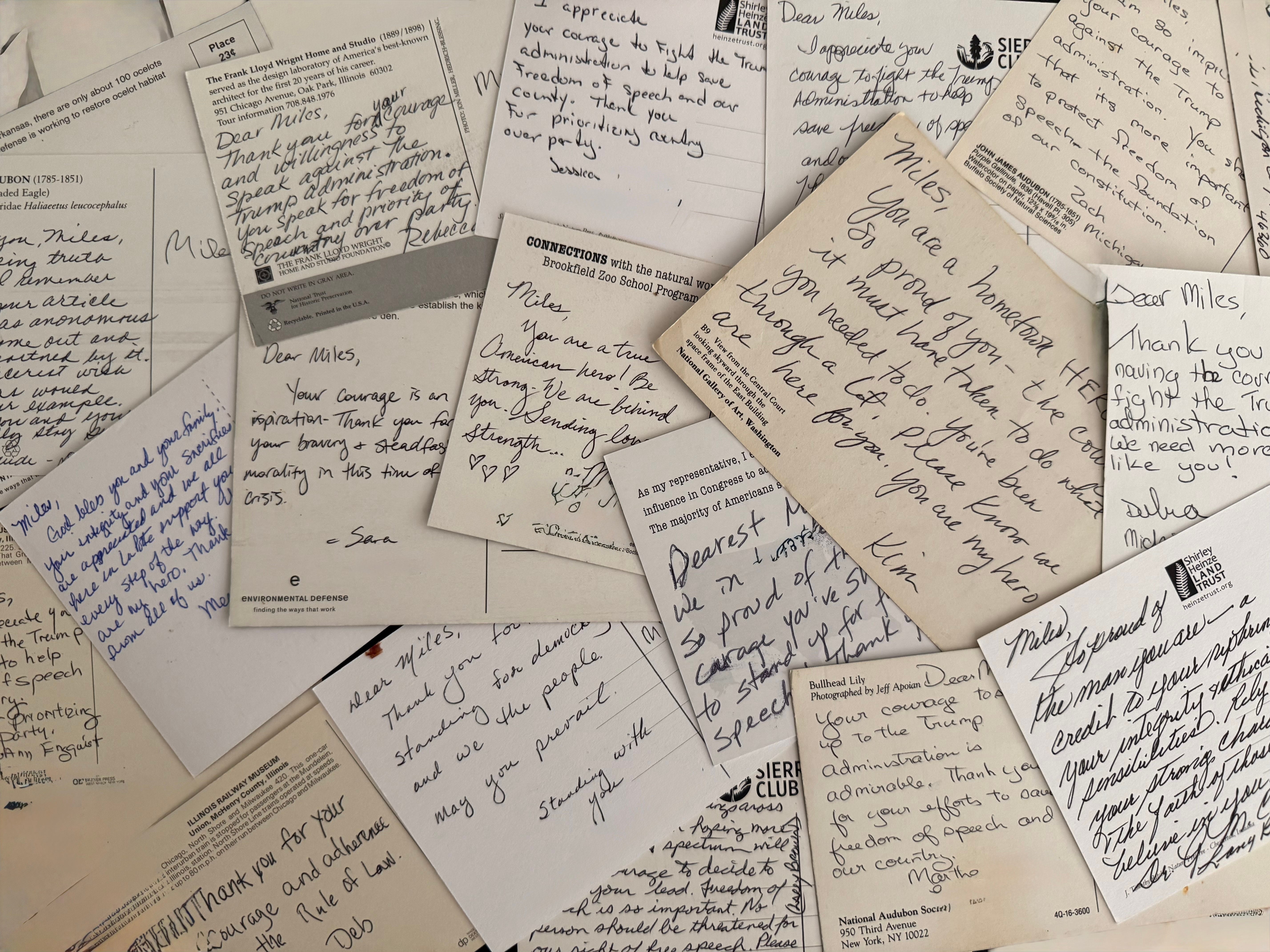
They were postcards. Dozens of them. Handwritten notes from people in her town and the towns around it, addressed to me, expressing solidarity, and urging us not to back down. The cursive of strangers turned out to be more affecting than the silence of my friends — friends who’d been in our wedding, who we’d known for decades, and who’d explained, with unsaid regret, that they’d need to keep their distance now to protect themselves. They couldn’t afford for their businesses to be targeted by Trump or to lose their security clearance, and so on.
These postcards were from people who owed me nothing and who had every reason to keep their heads down. They’d signed their names anyway. The president had warned that my associates would be investigated, too. Yet here were a bunch of folks I’d never met, willingly making themselves “my associates.” They’d tied themselves to me on paper and under their own signatures — and on postcards whose messages are readable by anyone in the open mail!
These strangers hadn’t arrived at such conviction on their own. Anne and her friends in a local Democratic group had gone person to person, asking neighbors to do a small brave thing by writing their name on a card in solidarity with a target of presidential revenge.
We just want you to know you are not alone, she said, handing me the stack. It was the first time in two months I’d believed those words.
I want to say something about how courage actually moves through a country, because I think we describe it wrong. We talk about it as if it were a personal virtue, something a person either has or lacks, summoned from within at some very decisive moment. That’s almost never the case.
Courage is like a moral bonfire. The big, old logs don’t get it going. The award-winning professor waits to see what the university does. The university waits to see what its peers do. The law firm waits for another law firm. The senator waits for a poll. We saw them all just sitting there last year, didn’t we? Meanwhile, down at the bottom of the stack, there’s a pile of unseen kindling. One small piece catches first. The rest follow.
Sometimes that twig is a sick woman who’s already lost more than most of them ever will and who’s knocking on doors and asking her neighbors to sign their names and in the process showing the big, old institutions what a conflagration really looks like.
This is the inversion at the heart of resistance movements, and we keep failing to notice it. The institutions with the most resources to defy are the slowest to do it. The individuals with the least to spare seem to be the ones to go first.
Thomas Paine saw this in the winter of 1776. The summer soldier and the sunshine patriot will, in this crisis, shrink from the service of their country. He wrote that in a pamphlet about the men with property, reputations, and the most to lose by losing the war. Paine saw them cowering. The institutions and many elites lost their nerve while farmers stood in the snow at the Delaware.
The phenomenon is obvious once again. The sunshine patriots are always the ones we expect to lead. But the real patriots are almost always the ones we didn’t see coming. Maybe they learned, with the passing of a husband or a degenerative condition, how precious life really is and how silence and inaction are tantamount to death.
Anne was one of those real patriots. She had no platform or fancy title. She had a disease that was killing her and a clock that I discovered — much too late — had already run out. Yet she spent some meaningful portion of what remained of her life nudging others to be honest with themselves and to be a little brave.
I think she did this because she understood, in a way our institutions still do not, that silence isn’t safety. Silence is the medium through which the threat travels. The only thing that interrupts it is someone (usually someone with no particular reason to go first) actually just straightening their shoulders and going first.
After June and the postcards, Hannah and I had many conversations. We resolved not to be silent again. Once we signaled plans to fight back, messages began to arrive from everywhere. Letters and emails. Direct messages and encouraging posts. I started keeping them on the coffee table in my office, where I’d see them in the morning and again at night.
For every friend who’d quietly stepped back, a stranger somewhere else stepped forward. They’d been watching, waiting, and looking for a sign that it was okay to speak out. Anne had been that sign for the people in her town. The people in her town, in their own handwriting, became that sign for me. I, in turn, became a sign for someone else I hope. This is how it works. This is the only way it’s ever worked.
I didn’t get to tell Anne any of this. When I heard she’d gone into hospice, I put a time on my calendar to search for flights so I could spend some time with her. She died two days later. I’ve been carrying around this thank-you since, and last night, I decided the only honest thing she’d want me to do with it is to give it to you, because if you’re reading this, there’s a real chance you’re reading it because of her, through some chain of events you can’t trace.
I realize that if there’s a thing to do with grief, whether for a person or a country, it’s to refuse to let the silence consume you. After accepting any dire situation, you move forward and go write the card you’re supposed to write or sign your name where it’s needed. You haven’t time to waste, so you say the obvious true thing out loud, especially in the rooms where it’s least convenient. You do it before you’re sure it’s safe.
Anne went first. I saw that as a little kid. She lived unafraid because she knew, more viscerally than most, that there wasn’t time to be anything otherwise. Time is precious. And she spent hers on us.
You are not alone.
Your friend, in defiance,

P.S. Miss the most recent DEFIANCE Daily? Our most recent episode is below. Also, don’t forget you can list to DEFIANCE Daily on Apple Podcasts, Spotify, or wherever you get your podcasts!
P.P.S. What’s coming up? We’re full-time focused on saving the republic. Join us for our next broadcast. Watch LIVE for free. Members get access to the replay.
DEFIANCE DAILY — Every weeknight @ 5pm ET. Watch our hour-long podcast LIVE on our DEFIANCE.News page, YouTube, or X — and listen on Apple Podcasts, Spotify, or wherever you get your podcasts!
WEEKLY MISSION BRIEFING — Every Wednesday @ 5pm ET. Same ways to watch, above! Replays available afterwards.
WEEKLY COFFEE — Every Friday @ 2pm ET. Join us on Substack or at DEFIANCE.News for Members-only coffee every Friday at 2p ET. Replays available afterwards.
MONTHLY MEMBERS-ONLY MEETING — First Wednesday of every month @ 5pm ET. These are sent out the week of, via Zoom. Replays available afterwards.
What a beautiful remembrance! I’m so proud to be a Defiance supporter and I hope your good work makes the difference we need! Thank you!
Touching and wonderful piece, brimming with humanity - both on the surface with the heartfelt story, and in the deeper meaning underlying that story. People DO Take strength from others who refuse to back down - people who "do what they do before they know it's safe." And courage really IS contagious. And it's among the things we need most.