


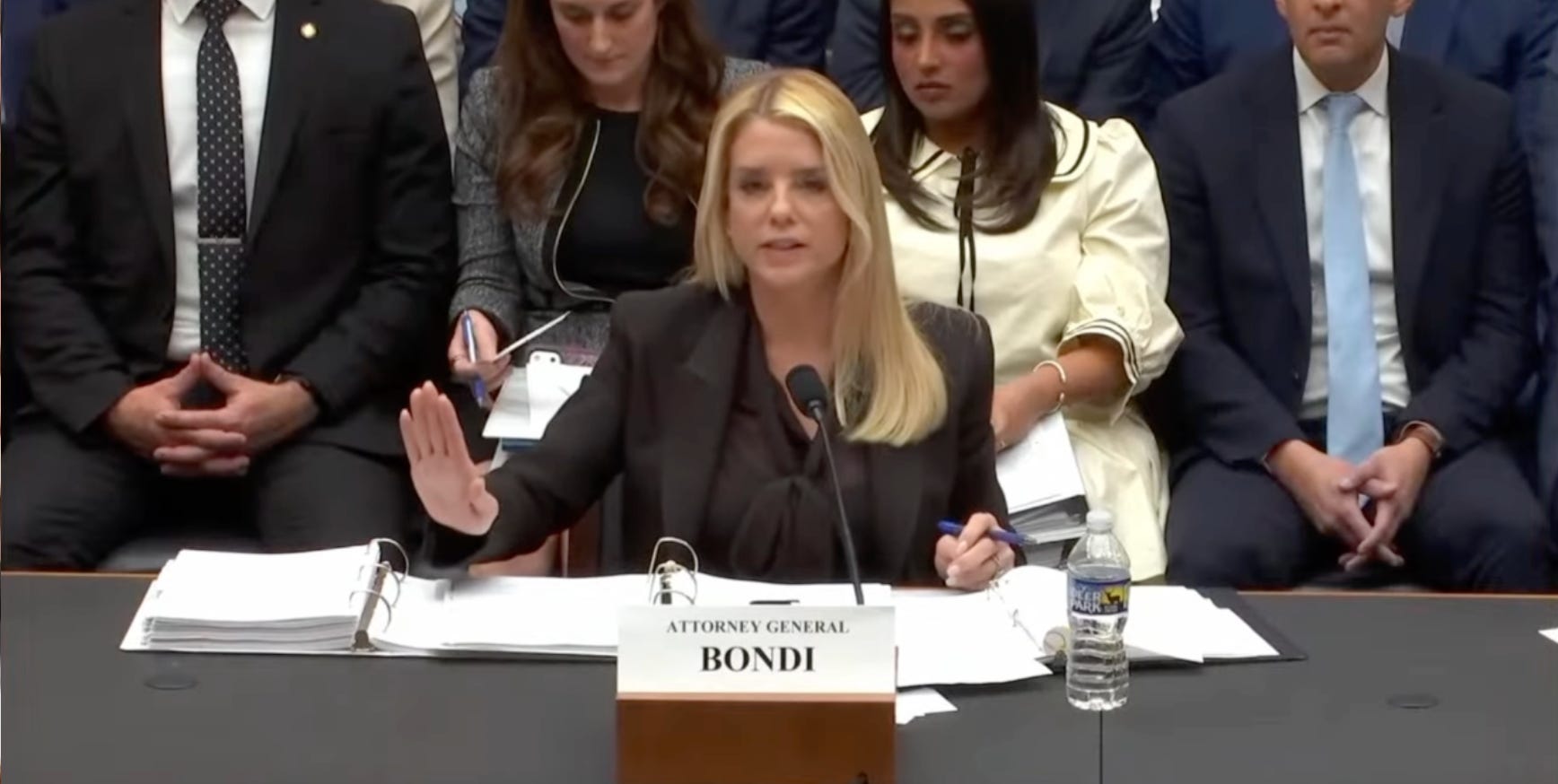
If you missed Pam Bondi’s testimony before the U.S. House this week, there’s no need to watch it. I spent a decade working on Capitol Hill. Never have I seen such an undignified display of absurdity, lies, and self-mockery. But there was one particular moment worthy of your attention. The short video is below. And it says a lot about the direction we are headed as a nation.
Here’s what happened.
Rep. Zoe Lofgren had just finished pressing the Attorney General on how the Justice Department handled the murders of two Americans. It was a pointed but substantive exchange. Bondi was then asked to respond. Instead of answering the question, she pivoted in the most bizarre way.
Read the transcript yourself:
REP. ZOE LOFGREN: …So I really think that is a disgraceful approach to the homicides of American citizens and really does nothing to bring credit to your department. And, Mr. Chairman, I would yield back.
CHAIRMAN JIM JORDAN: The Gentlelady yields back.
ATTORNEY GENERAL PAM BONDI: May I answer?
JORDAN: The attorney general can respond.
BONDI: I find it interesting that she keeps going after President Trump, the greatest president in American history! And if they could maintain their composure…
(THE ROOM FILLS WITH LAUGHTER)
BONDI: … this isn’t a circus! This is a hearing! I find it interesting she keeps going after Donald Trump!
(I could write a whole piece on the irony of Pam Bondi calling the hearing a circus; indeed, if you watch this supercut, you’ll see how she made it one).
But it’s this particular line I want to focus on — the part where she claims Donald Trump, “the greatest president in American history!” It would be easy to dismiss this as bluster. But the phrase has become something more than a flourish. Trump has long described himself as the greatest president “since Lincoln,” sometimes suggesting the comparison undersells him. His underlings have noticed.
Increasingly, members of his administration and allies in Congress echo the formulation reflexively. Stephen Miller says Trump “has literally saved America.” Rep. Lauren Boebert calls him “the greatest president of my lifetime.” Rep. Elise Stefanik says he’s “the strongest president in modern history.” And not to be outdone, Sen. Lindsey Graham argues he is “the greatest president of all time.” DHS Secretary Kristi Noem, without a hint of sarcasm, even lauds the president for having the supernatural power to stop hurricanes from hitting the United States.
In democracies, this kind of praise feels almost intentionally comical. But in autocracies, it’s the price of admission.
Political theorists have long observed that authoritarian systems are sustained by fear and ritualistic praise of the leader. If you want a job in government — or even to receive your welfare benefits on time — loyalty must be performed in public and genuine caution must be exercised in private. You never know who will rat you out. The lavish, over-the-top, “dear leader” language becomes something of a passphrase required for continued survival.
Soviet dissident Aleksandr Solzhenitsyn captured this dynamic in one of his most famous books, The Gulag Archipelago. I re-read it not long ago. In the earliest part of the tome — before Solzhenitsyn is imprisoned for years and years — he recounts a story from 1937, which has been retold throughout the decades. Here’s how he insists the event “actually occurred,” and it’s important for us to follow the story closely.
That year, a district Party conference was underway in Moscow Province. At the close of the meeting, “a tribute to Comrade Stalin was called for.” Everyone rose. The hall erupted in what Solzhenitsyn describes as “stormy applause, rising to an ovation.”
It went on. “For three minutes, four minutes, five minutes,” he writes. Arms were raised and palms struck, over and over. Their faces were arranged into expressions of fervor.
But the applause didn’t stop.
“Palms were getting sore and raised arms were already aching. And the older people were panting from exhaustion,” he writes. What had begun as ritual enthusiasm became something else. “It was becoming insufferably silly even to those who really adored Stalin.”
Still, no one sat. Why? Because, as Solzhenitsyn notes plainly, the secret police “were standing in the hall applauding and watching to see who quit first.” The applause stretched to six minutes. Seven. Eight. Keep in mind, this was an obscure and small conference hall that Stalin didn’t even know was being used for a meeting.
“Nine minutes! Ten!” he writes, in short, anxious bursts. The district Party secretary stood on the platform. He could have ended it. “But he was a newcomer. He was afraid,” Solzhenitsyn says. To stop first was to distinguish oneself, and to distinguish oneself was to invite suspicion.
“At the rear of the hall,” he notes, some attendees could cheat by clapping less vigorously and easing the tempo. But up there on the platform where everyone could see them, no one stopped at all. They were terrified.
The director of a local paper factory, described as “an independent and strong-minded man,” understood the absurdity of the spectacle. “Aware of all the falsity and all the impossibility of the situation, he still kept on applauding.” But he was watching it all warily. They were trapped inside a performance they no longer believed.
“To the last man!” Solzhenitsyn writes. “With make-believe enthusiasm on their faces, looking at each other with faint hope, the district leaders were just going to go on and on applauding till they fell where they stood.”
Then, after eleven minutes, something shifted. The director of the paper factory assumed a businesslike expression and sat down in his seat. That was it.
A miracle followed.
“To a man,” he writes, “everyone else stopped dead and sat down.” The applause ceased instantly. The fever broke, and the hall returned to ordinary air. They had been saved, Solzhenitsyn notes with bitter irony, by “the squirrel…smart enough to jump off his revolving wheel.”
That night, the factory director was arrested. The authorities charged him with some invented infraction, and he eventually got ten years in prison. The regime had learned what it needed to know. “That…was how they discovered who the independent people were,” Solzhenitsyn writes, “and that was how they went about eliminating them.”
After signing the final interrogation document, the factory director allegedly got a piece of advice. His interrogator told him bluntly:
“Don’t ever be the first to stop applauding.”
You can see why this story captured my attention.
America is not Stalin’s Soviet Union. Not yet. No one in Congress faces imprisonment for insufficient applause. But we’re not far from it.
A few months ago, six Democratic lawmakers made a video urging U.S. troops and intelligence personnel to refuse illegal orders. They told government workers to obey the Constitution. For that, U.S. President Donald Trump called for them to be arrested and suggested they should be hanged. This week, Trump’s prosecutors tried to charge them with a crime and have them imprisoned. A grand jury refused. But I’m told they are going to try to charge them again.
I have a few serious questions for anyone reading this morning’s essay.
Do you think that’s the end of it?
Do you think this effort to jail Trump’s opponents is an anomaly?
Do you think all of this will somehow just “go away” if we ignore it?
It’s easy to deny what’s happening in our country. I get it. Admitting that America — the light of the free world for 250 years — might be fundamentally at risk of democratic failure is scary, to say the least. Very scary. But denial is what will turn our fears into self-fulfilling prophecies. I promise you that.
I’m highlighting this example because sometimes the little moments tell the story better than the big data. When we get too wrapped up in documenting Trump’s abuses of power, we lose the plot inside the numbers. The media counts how many laws Donald Trump has broken and how many vile things he has said and how many provable falsehoods he spews in each speech and how many people, on average, he seeks revenge against each week by weaponizing his office (at last count, according to Reuters, it’s more than one a day).
But the way people in Washington are speaking can tell us this story a lot more plainly.
The most revealing aspect of Bondi’s absurd praise for Trump this week was that it was reflexive. It wasn’t part of a pre-planned speech. She was a pull-string doll on a loop, programmed to say what she needed to say to survive. That’s because Bondi knows something that many of us don’t. To stay afloat and thrive in this new America, you must love the leader and love him loudly, just in case he’s watching.
Attorney General Pam Bondi showed us all the new pledge of allegiance.
In systems organized around one figure’s approval, silence is dangerous. As Bondi knows, even insufficient enthusiasm carries real consequences — from loss of access and influence to potential dismissal and even persecution. That’s why Trump’s cabinet meetings have turned into bizarre, self-aggrandizing spectacles, with each senior official trying to outdo the next in their glorification of the president’s greatness, while he nods off comfortably, knowing that he’s not only captured the attention of his minions but also their souls.
All the while, the clapping goes on longer.
The question facing us is not whether Donald Trump is the greatest of all time or just the best in modern history. The question is why so many public officials now feel compelled to offer up such foolish, maximalist assessments at all. In political cultures that are confident in their institutions, leaders are evaluated on performance and fired for their failures. In political cultures that begin to orbit a single personality, leaders are exalted — no matter what — and are never questioned.
Which one do you sense we are living in today? Or veering toward?
You’ll get a firsthand look on February 24th, during Donald Trump’s first State of the Union Address back in office. That night, I want you to watch the proceedings closely, if you can stomach them. And I want you to make up your own mind about whether Republicans are clapping in celebration… or whether it’s a precaution. That should tell viewers everything they need to know about what’s happening in America.
Your friend, in defiance,
Miles Taylor

When I heard Bondi say, "all the good things Trump has done" I wanted to scream at my computer!! He has done nothing good for Americans, everything he does is self-serving. He has done more to destroy America than any foreign spy could ever hope to do. On that note and I am not one for conspiracy theories, but the only thing that makes sense is that he is a Russian asset and Melania is his KGB handler.
I actually won't be able to listen on February 24. I'll read about it because I want to be informed, but I can't actually sit (or stand or recline) and listen to him proclaim his toxic nonsense! We are sliding toward the need to clap forever or be charged and thrown into prison. I'm, however, holding on to the idea that too many of us are holding onto the Constitution and not to the coattails of DJT!