


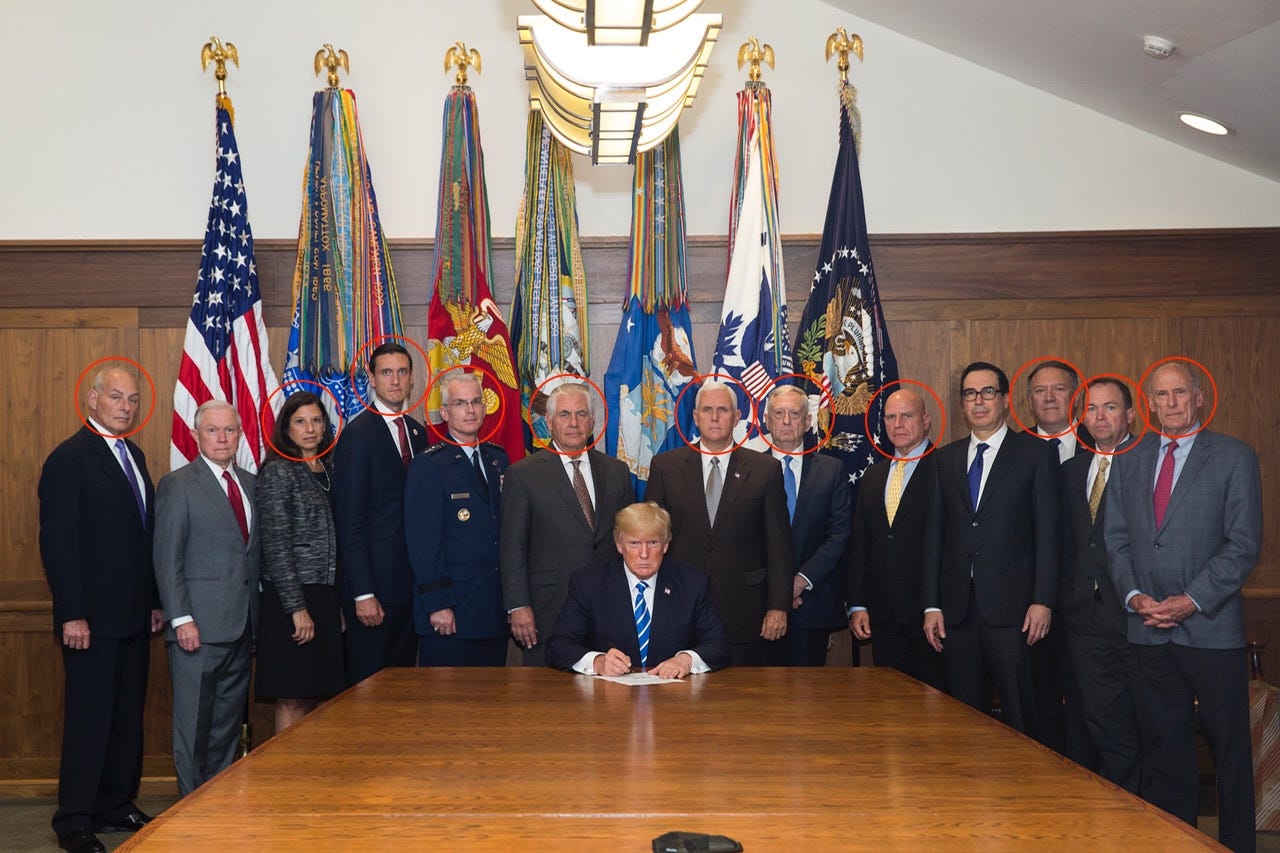
Before the 2024 election, my former boss John Kelly warned the world that Trump fit the “definition of fascist.” Recent events make those comments seem prescient. So I went back to assess — How many people on Trump’s original national security team came away with similar feelings? My conclusion: more than half.
We’re not talking about liberals and RINOs. We’re talking about Donald Trump’s own hand-picked National Security Council (NSC) in the first administration. Over four years, more than two-dozen different people held the top NSC roles — such as Secretary of State, Secretary of Defense, White House Chief of Staff, and National Security Advisor — including former Republican governors, congressmen, generals, ambassadors, and more. The majority came away despising Trump and fearing he was a threat to democracy.
Most didn’t know Trump well personally when they came into their jobs. But they left office warning in public or in private that Trump was a “moron,” an “evil man,” a “disease,” a “threat to democracy,” and a “fascist.” That’s based on my direct conversations with those leaders and their teams when I served in the first Trump administration, in personal interviews with them after they left office, or their own public comments and conversations with journalists.
This matters because Trump’s current GOP enablers continue to shrug off the critique that the president is embracing authoritarianism as an unhinged, left-wing talking point. In reality, my analysis finds that most of the president’s core national security team concluded that he had the identifiable characteristics of a despot — well before he returned to office for a second term.
Yesterday, the New York Times published a disturbing interview with Donald Trump in which he spoke about the limitations on his power, or lack thereof. He stuck by his long-held view that the presidency is all-powerful, saying he still didn’t really view any limitations to his authority. Except for himself.
“[O]ne thing: my own morality. My own mind. It’s the only thing that can stop me.”
That’s not a slip-of-the-tongue moment. It’s what he believes. In the past, Trump said, “When somebody is president of the United States, the authority is total,” even calling for “termination” of parts of the Constitution. Last month, his current White House chief of staff, Susie Wiles, reaffirmed that the president sees his power as unconstrained, operating with a view that:
“[There’s] nothing he can't do. Nothing, zero, nothing.”
Donald Trump’s actions in recent months show he believes there are no limits: Deployments of troops onto U.S. city streets. Invasions of foreign capitals. Violations of court orders. Ignoring laws passed by Congress. Deletions of federal agencies. Revenge investigations into his enemies. Terminations of federal aid to Blue States. Musings about arresting sitting governors and suspending habeas corpus. Designations of the political opposition as domestic terrorists. And so on.
Dozens of federal judges ruled last year that the Trump administration broke the law and violated the Constitution, in a slew of cases, making it the most “lawless” first year of any presidency in modern history. Yet the willful indifference of the GOP continues, with party loyalists brushing these decisions off as the rantings of activist judges, despite the fact that many of those judges were Republican appointees or placed on the federal bench by Trump himself.
But the GOP cannot ignore what Trump’s own team has said. And now more than ever — with the president toying with “canceling” elections and seizing NATO territory — Republicans need to know that the president’s closest advisors (who he charged with protecting the country) warned that he had dictator-like qualities or designs. Indeed, no American president has ever seen so much of his own cabinet turn against him, let alone his personal national security team.
The majority of Trump’s national security team warned about his reckless and autocratic tendencies.
By my count, there were sixteen key roles on Trump’s NSC. Over four years, that security cabinet was led by a rotating cast of 32 senior leaders. Of those 32 senior leaders, at least 19 of them publicly or privately warned of the danger posed by Trump, his instability or unfitness for office, and/or his authoritarian desires. I struggle to find anything comparable in recent American history, or in all of it for that matter.
The list includes the following (with the harshest criticisms shared by the names in bold): Mike Pence, Rex Tillerson, Mike Pompeo, Steven Mnuchin, James Mattis, Mark Esper, Jeff Sessions, William Barr, Rick Perry, Dan Brouillette, John F. Kelly, Kirstjen Nielsen, Chad Wolf, Nikki Haley, Michael Flynn, H.R. McMaster, John Bolton, Robert C. O’Brien, Joseph Dunford, Mark A. Milley, Dan Coats, Joseph Maguire, Tom Bossert, John Ratcliffe, Gina Haspel, Reince Priebus, Mick Mulvaney, Mark Meadows, Russell Vought, Elaine Duke, Robert Lighthizer, and Wilbur Ross.
Don’t take my word for it. Take theirs.
Former Vice President Mike Pence called Trump “reckless” and a “disgrace” for putting democracy in danger and threatening the lives of elected leaders on January 6, suggesting he put “himself over the Constitution” and “should never be President” again.
Former White House Chief of Staff and DHS Secretary John Kelly told me Trump was “a very, very evil man” and said the president “prefers the dictator approach to government.”
Former Secretary of Defense Jim Mattis told me Donald Trump was “a threat to the very fabric of our republic” and warned widely that the man had the understanding of a “fifth or sixth-grader” and wanted “to destroy trust” in our democratic system and “to poison our respect for fellow citizens.”
Former Chairman of the Joint Chiefs of Staff Mark Milley declared that Trump was “fascist to the core” and “the most dangerous person to this country.”
Former Secretary of Defense Mark Esper vocally warned that Trump was “a threat to democracy” and that he was a “clear and present danger” to the United States.
Former National Security Advisor John Bolton told me the president had fomented an insidious, anti-democratic movement that was “like a progressive disease” inside of our republic, in addition to alerting the public that Trump was “determined to destroy American democracy.”
Former Attorney General Bill Barr said Trump’s behavior in 2020 was “detached from reality” and asserted that the man committed a “betrayal of his office.”
Former Secretary of State Rex Tillerson worried that Trump’s impulsiveness was causing “chaos” inside the U.S. government and derided him as an “undisciplined” “moron” with an inclination toward breaking the law.
Former Secretary of State Mike Pompeo once told me Trump was “a coward and a bully” and later slammed him for being careless with national security secrets.
Former Director of National Intelligence Dan Coats lamented: “He doesn’t know the difference between the truth and a lie” and had “no moral compass.”
Former Homeland Security Advisor Tom Bossert vented that Trump was “the most distracted person in the world,” clueless on the issues, and emphasized that aides equated him to a “madman in a circular room screaming.”
Former CIA Director Gina Haspel feared Trump was fomenting “a right-wing coup” from inside the White House and governing like “a six-year-old with a tantrum.”
Former Acting DHS Secretary Elaine Duke blasted Trump as “hate-filled, angry, and divisive” with a worldview that shifted from “America First” to “America only” in ways that fundamentally betrayed the country’s values.
Former National Security Advisor H.R. McMaster made clear that Trump had fomented an environment of “competitive sycophancy” around himself, was “addicted to adulation,” and “sees in authoritarian leaders the qualities that he wants other people to see in him.”
I could go on. But you get the point. Although a few people on the full list decided not to oppose Trump’s re-election in 2024 (or have laid low recently in their criticisms), their original critiques in public or behind closed doors cannot be erased or forgotten. Certainly not by me.
So ask yourself this: Is it just a coincidence that so many people close to Trump — especially those responsible for national security — came away fearing who he really was? Are they all just disgruntled employees? Are they Deep State conspirators? Or, perhaps, were they canaries in the coal mine?
We are seeing hints of defiance once more within Trump’s ranks, at least in Congress. Rebellious conservatives have stood up to him on controversies like the Epstein scandal and on rising tariffs, and last night Senate Republicans defected to limit Trump’s power to invade Venezuela, while House Republicans defied Trump to extend healthcare subsidies.
Still, we’re in the throes of a broader constitutional crisis in the United States. One year back in office, the president is abusing his power in ways that are testing — and demolishing — the foundations of a free society. While saying “I told you so” won’t get us through it, perhaps something else will: reminding more Republicans that it’s okay to listen to their consciences, as others around Trump once did. Indeed, our nation’s future may depend on it.
Your friend, in defiance,

P.S. WHAT’S HAPPENING ON DEFIANCE.NEWS
Here’s what’s coming up.
LAST NIGHT // DEFIANCE Daily, feat. best-selling author Jason Stanley - Watch the replay of our eye-opening conversation with author of runaway bestseller How Fascism Works, Jason Stanley.
TODAY // Weekly Coffee // 2p ET - Join us for another Weekly Coffee, where you can ask questions about anything! Members-only chat. Join us LIVE on our DEFIANCE.News page, or watch the replay.
TODAY // DEFIANCE Daily, feat. former Trump spy chief Sue Gordon AND former Pentagon correspondent Barbara Starr // 5p ET - Sue and Barbara are back with us to shed light on the national security and global implications of the invasion of Venezuela and the White House’s targeting of other countries.
NEXT WEEK TEASER - We’ll be having conversations on DEFIANCE Daily with former Governor Marc Racicot, best-selling author Marianne Williamson, Congressional candidate George Conway, and more.
ONE MORE THING: WE HAVE BUTTONS. By popular demand, we have added buttons — yes, the kind you can pin on your jacket, t-shirt or backpack — to the swag store. Check out www.DEFIANCE.org/swag and scroll to the bottom. All proceeds go toward our weekly counter-Trump efforts.
Yet, that group of people did virtually to work against Trump's reelection bids in 2020 or 2024, even afterhe'd sent his storm troopers into the Capitol to steal an election and hang Mike Pence and others. They, as much as his rabid supporters, deserve the blame for where we are today. They should have been on their 'horses,' waving their lanterns and screaming, "The Fascists are coming." But they remained mostly silent, and some of them, like Bill Barr, said that he would vote for Trump in 2024. They all failed the test of statesmanship. They all failed to live up to their the Constitutional oaths. They failed America and the world. "Silence always favors the oppressor." They, mostly, chose silence.
The Supreme Court in Trump v United States (7/1/24 - before Trump was elected) functionally ceded all congressional power to the President. Ketanji Jackson warned this would happen but it was already planned to happen by the $$$$$ people.
Jackson concluded by saying in her dissent: “The majority of my colleagues seems to have put their trust in our Court's ability to prevent Presidents from becoming Kings through case-by-case application of the indeterminate standards of their new Presidential accountability paradigm. I fear that they are wrong. But, for all our sakes, I hope that they are right.
In the meantime, because the risks (and power) the Court has now assumed are intolerable, unwarranted, and plainly antithetical to bedrock constitutional norms, I dissent.”