


Donald Trump’s desire to invoke one of the presidency’s most extraordinary, emergency powers is ten years in the making. I believe he will do it. And I believe we have real options to fight back.
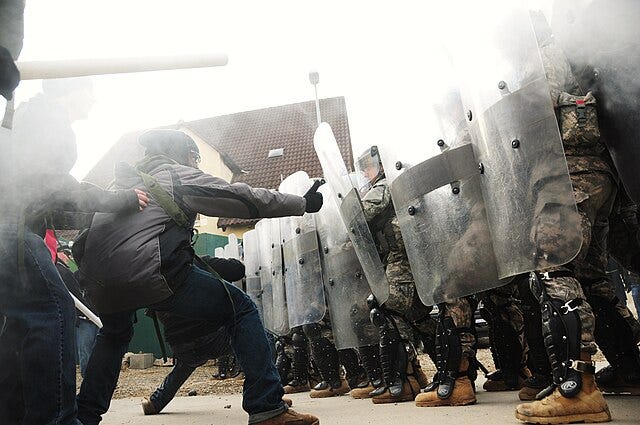
As news outlets reported this week, the White House is openly threatening to deploy U.S. troops into Minnesota under the Insurrection Act after protests erupted following the killing of Renee Nicole Good by an ICE agent. Federal forces have already flooded Minneapolis. The president is now warning that unless the state “stops the professional agitators and insurrectionists,” he will send in the military using one of his most extraordinary powers.
Contrary to the analysis of many pundits, this isn’t bluster. It’s the culmination of a nearly ten-year fixation I witnessed firsthand inside Donald Trump’s first administration.
Last night I went on Jen Psaki’s show on MSNOW to explain why this moment has been coming for a decade — and why Trump has always wanted to test the outer limits of his “apex” powers.
We’ve been here before. In fact, I watched Trump nearly invoke the Act — and talked him out of it.
I’ve written repeatedly about the Insurrection Act because I saw how dangerously close we came to it during Trump’s first term. Indeed, it was the very first thing I disclosed when I first came forward against the president ahead of his re-election campaign.
In 2019, while I was chief of staff at the Department of Homeland Security, Trump nearly used the Act to dramatically militarize the Southern Border, where he’d openly mused about repelling migrants by force, i.e. shooting them.
I got a phone call that tipped me off. Trump had just watched cable news footage of a migrant caravan approaching the Southern Border, and he was furious. Aides alerted me that he wanted to announce in his State of the Union address that he was sending the military to take over border security and to override any objection, law, or court.
Our lawyers told us this was madness. This didn’t rise to the level of a “foreign invasion.” Not even close. I agreed. What’s more, we feared that if he did this at the border, it would be a slippery slope: he’d send the military anywhere in the country that he wasn’t getting his way.
When the Secretary and I got to the White House, the President was practicing his speech in the Map Room. He greeted us with a grin, as if unable to hide his excitement at preparing to exercise a power he’d been told was one of the “break glass” emergency authorities of the presidency. We immediately set about convincing him this was the “wrong time” to do such a thing and the “wrong circumstances.”
What followed was a torturous night of ping pong. We enlisted the White House lawyers to help us persuade the boss. We called the Secretary of State. We phoned colleagues in the Government of Mexico to see what more they could do to tamp down the caravan. And when we persuaded him the situation was under control — and couldn’t possibly warrant the use of powers meant for wartime — he eventually (and begrudgingly) relented.
But after that moment, it was clear: he would try again.
In fact, he never let go of the idea. On other occasions in conversations with us, he referred almost wistfully to the Insurrection Act as his “magical authorities.” He believed — and still believes — that Article II of the U.S. Constitution allows him to do “whatever I want as President.”
Since returning to office, Trump has been trying to foment an “insurrection” or “rebellion” to justify emergency action.
Last year I warned repeatedly that Donald Trump was edging toward this moment. He began experimenting in Los Angeles, pushing troops beyond their lawful support roles, daring the courts to stop him. The very day he announced he was sending the Marines into California last June, I wrote this:
This could be the beginning of Trump’s worst abuse of power. Who is to say he won’t send U.S. troops into each “Blue State” that opposes his policies? Or to shut down organizations he doesn’t like? Or to round up his critics?
That’s almost exactly what has happened since (including the White House putting in place measures to designate opposition groups and individuals as “domestic terrorists” and to charge his opponents with fake crimes). They tried to create the circumstances that would justify an invocation. They probed Los Angeles. They probed Chicago. They probed Washington, D.C. They probed Portland.
In each case, the opposition refused to play the role Trump and Stephen Miller wrote for them. Protests were loud but largely peaceful. And local officials kept order, meaning that suddenly invoking the Insurrection Act would not have passed the laugh test.
What’s more, the courts shot down those National Guard and troop deployments. From California to Washington, D.C., federal judges ruled that the president’s actions were flat-out unconstitutional. On New Year’s Eve, Trump quietly and ruefully said he was withdrawing the National Guard — but hinted ominously at what was to come.
Perversely, those rulings only accelerated his interest in the Insurrection Act, the one statute that could give him a colorable excuse to send the military back in and make it harder for the courts to constrain him.
Here’s why Minnesota might be different.
Knowing these people, I strongly suspect the Trump administration studied the map of American unrest the way a fire inspector studies old burn scars on a building’s walls. That’s why cities with a big protest history (LA, DC, Chicago, Portland) were up first. But they didn’t deliver.
Then, White House aides remembered 2020. Specifically, I imagine they recalled how the George Floyd protests in Minneapolis became a national symbol at the end of Trump’s first term, and they knew it could be a potential powder keg.
So they poured in thousands of federal agents, under the flimsy excuse that kindergartens run by Somali-Americans were rife with fraud — as if that’s the type of national security threat that requires shock troops instead of investigative accountants. The tension rose the past few weeks, by design. Then an ICE agent shot and killed Renee Nicole Good. While I don’t believe her death was part of some scripted plot, the confrontational posture made such a tragedy more likely.
Now the White House is gathering the visuals it was hoping for. They’re asking ICE officers to grab street footage for them, too, in an effort to document clashes, grieving crowds, and a state under pressure. Trump’s message is predictable and pre-planned: Nothing can fix this but the U.S. military.
Trump’s use of the Insurrection Act would surely be illegal. Here are a few ways I think we can stop him.
The Insurrection Act was written in 1807 to repel invasions and suppress genuine rebellions. It is meant to be a last resort when states cannot protect constitutional rights or enforce federal law. Minnesota does not meet that standard, by any stretch of the imagination. The state retains full control of its own National Guard, local police and courts are functioning, there’s no observable “insurrection” in sight.
In fact, using the Act there would invert its purpose. The federal government would be deploying troops against a state that is capable of maintaining order, simply because the president dislikes its politics. Courts should absolutely strike this down. But Trump has never treated the law as a guardrail, and he’s counting on the fact that federal courts will be slow to respond.
Despair is exactly what the White House wants. However, there are practical, powerful steps federal, state, and local leaders can take to check Trump’s wayward use of his presidential power if he invokes the Act.
First, Minnesota should sue and strip away the pretext. The governor and attorney general could seek a declaratory judgment that the Insurrection Act’s conditions are not met and that the state retains primary authority over public safety. Minnesota should simultaneously build the factual record: activated National Guard units under state control, mutual-aid agreements, functioning courts, and certifications from law-enforcement leaders that order can be maintained. A formal declaration of capacity would gut Trump’s claim that only the U.S. military can restore peace.
Second, other states MUST move together. It’s time for the governors to have an emergency summit. Illinois, California, Oregon, and others should file parallel briefs stating they will not consent to federal military policing within their borders and will challenge any similar deployment. Governors should convene in emergency session to adopt a joint compact defending federalism and coordinate Guard resources so no state can be isolated and bullied. Unity is a legal shield and a political deterrent, and we are LONG overdue for the governors to come together to show that.
Third, Congress must put the military on notice, immediately. Members should announce they will open Congressional investigations into any manifestly unlawful orders issued under a sham invocation of the Act, with inspectors general requests and committee subpoenas ready to go. Uniformed leaders need to hear, before a single deployment, that obedience to manifestly illegal commands carries personal and institutional consequences. This is not intimidation; it’s a reminder of their oath to the Constitution.
Fourth, impeachment must begin the moment he acts. Even if today’s GOP majority in the House blocks impeachment proceedings, opposition Members of Congress should file articles of impeachment and create the constitutional record that courts and future Congresses will rely upon. Silence would be treated as acquiescence. And if Democrats retake Congress, those proceedings can and must resume where they left off. Donald Trump fears impeachment if he loses the midterms, and he should.
Fifth — and most importantly — this would be a moment for mass civic resistance. If U.S. troops are sent against an American state, the response must be the largest peaceful mobilization in our history. By that, I mean coordinated marches in every state capital and cities large and small, labor walkouts, faith leaders in the streets, veterans standing between soldiers and citizens, mayors opening city halls for lawful assembly, and more. Trump is portraying the opposition as “terrorists” and “insurrectionists”; millions of calm Americans can shatter that illusion overnight.
This is not an exhaustive list. There’s a great deal more that can be done. And in the coming days and weeks, those options will be fleshed out. What we cannot do, though, is be lulled into a false sense of comfort that this is another Trump “joke” and not the real thing. We have to be ready.
Like I’ve said, again and again, Trump has been rehearsing this play for a decade. I watched the dress rehearsals. This time he believes the stage is set. But it isn’t, unless we surrender it to him. The Constitution still works when Americans use it, and the United States won’t become a despotism unless we allow it to be one.
Before that ever happens, we have options to fight back — lawfully, peacefully, and defiantly.
Your friend, in defiance,

P.S. WHAT’S HAPPENING ON DEFIANCE.NEWS
Here’s what’s coming up.
LAST NIGHT // DEFIANCE Daily - Watch the replay. We talked about Trump’s threat to invoke the Insurrection Act, welcomed one of the top police-reform experts in America, and had a moment of humor, levity, and inspiration with one of the most famous protesters in America: Robby Roadsteamer.
TODAY // Weekly Coffee // 2p ET - Join us for another Weekly Coffee, where you can ask questions about anything! Members-only chat. Join us LIVE on our DEFIANCE.News page, or watch the replay.
TONIGHT // DEFIANCE Daily // 5p ET - Watch LIVE on our DEFIANCE.News page, on our YouTube channel, or on my X account.
Miles Taylor has the real inside story about Trump because he served in his first administration. I read Miles book Blowback years ago. It was a warning of what would happen if Trump got a second term. The book is exactly spot on and now we suffer daily the consequences of this evil ignorant dictator in our precious White House.
The question remains: Who or what will stop Trump if he chooses not to follow a legal determination? He has already shown a lack of respect for the law.