


I’ve spent most of my adult life tied — in some way — to the Department of Homeland Security (DHS). From the White House and Capitol Hill to the upper echelons of DHS itself, I believed it was the future of our defense against foreign threats and terrorists. Now it’s being used to terrorize Americans. And I must concede that its critics were right: the young department was susceptible to abuse, it’s now rife with corruption, and when Trump is gone, it must be remade entirely.
That is, unless we want a police state.
I came to Washington after 9/11 because I believed the government had to be rebuilt, fast. America needed a new kind of agency that could prevent another morning like that one. I was on the House floor as key legislation moved to make it happen. I was in the DHS Secretary’s office during the Bush years, watching a newborn department learn how to walk. And I spent years on Capitol Hill overseeing DHS budgets, programs, and performance — the unglamorous plumbing that turns a government bureaucracy into a machine for detecting threats.
Then I went back into DHS during the first Trump administration.
I encountered something I never expected to see inside my own government: a president who wanted to use DHS against the people, not to protect them.
Well before he ever set foot in the White House, it was obvious Trump was an undisciplined narcissist. I was under no illusions. But that didn’t mean he was going to hijack agencies and use them for revenge and repression. Yet in the early days of his first term, it became clear how magnetically attracted the president was to the Department’s power, judging by the exhaustive micromanaging we received from him and his almost clinical obsession with our law-enforcement agents.
He couldn’t have cared less about the Department’s myriad missions. DHS had two things he really liked — badges and guns — and it had lots of them. Indeed, it is America’s largest federal law-enforcement agency, and Donald Trump soon saw those gun-toting agents as his agents, not just the nation’s. They were a means to an end. As Trump told us face-to-face on several occasions, if there’s one thing he learned in business, it’s that you need leverage over people to get what you want from them.
Nothing gives you leverage like a gun.
What followed was the most pride-swallowing two years of my life. I came into the job hoping to do right by the Department’s nearly 250,000 public servants by helping them combat cyber threats, foreign spies, cartels, terrorists, and other emerging dangers. Instead, we spent most of our time grappling with the impulses, whims, and illegal fantasies of one man. He wanted to use DHS as a cudgel against immigrants, Democrats, local leaders who disrespected him — you name it.
We were in an almost daily fight with the President of the United States to keep him from breaking the law and violating the U.S. Constitution. Sometimes we succeeded quietly. Sometimes we failed spectacularly. Sometimes my colleagues withered in fear and capitulated to the man, not wanting to see their careers ruined by him.
So I quit with a singular mission. I wanted to make sure America knew how bad it really was — and how bad it would get if we gave Donald Trump the keys again. Yes, Trump had been able to do bad things with DHS in his first term, but I didn’t think folks understood what his true vision was. Stepping forward would blow up my life, especially if Trump got re-elected; I did it anyway. And I took relief when the nation threw him out of office. The worst had been avoided.
But four years later, Americans returned him to office anyway. What has unfolded since has been both predictable and predicted. Today, we are watching the darkest nightmares of a weaponized DHS come to fruition, as the Department is transformed end-to-end into Donald Trump’s “pocket police.”
Unfortunately, the danger won’t go away when he does.
DHS has become what its critics feared.
Last week, The Atlantic’s Nick Miroff published a piece that landed like a punch when I read it: “Maybe DHS Was a Bad Idea,” he wrote. His thesis reflected what a lot of us have been thinking and feeling. The Department created in the shadow of 9/11 has shifted from defending America against foreign threats to deploying federal power on American streets and using the rhetoric of “terrorism” to justify it.
Look at what went down in the past few weeks.
DHS social-media accounts mused on New Year’s Eve about mass deportations in the breezy iconography of a vacation advertisement. Then DHS agents were dispatched for their largest deployments in history to Minnesota, under the thin veneer of investigating alleged accounting discrepancies at Somali-American kindergartens. What followed was a breathtaking and aggressive crackdown, in which two innocent U.S. citizens were killed at the hands of DHS agents and branded “domestic terrorists” before facts were established, before investigations had even begun, and before the public could get its hands on contrary evidence.
The escalation was extraordinary, even for Trump. In mere weeks, DHS went from shitposting on social media to gunning down protesters as “terrorists.”
The damage isn’t confined to Minnesota. When the government flips the term “terrorism” against its own people, the public hears that America’s extraordinary national-security powers are being justified for use against them, such as surveillance, databases, watchlists, and militarized operations. And when the president himself tells agents to use “whatever means necessary” against protesters — or the Vice President says officers have “absolute immunity” after killing civilians — ordinary people everywhere rightfully worry that they’re under siege.
How do you explain agents telling citizens who film them that they’ll be added to terrorist databases? Trump defenders will shrug off such remarks as the words of a rogue officer. Hardly. None of these are disconnected incidents. They’re the result of orders from the White House and the infrastructure to execute those orders.
In September, the White House issued NSPM-7, a presidential memorandum on “Countering Domestic Terrorism and Organized Political Violence.” I’ve been writing extensively, along with the incredible Ken Klippenstein, about this unconstitutional attack on free speech. Read the document and you see the danger: a sweeping directive to federal law enforcement to go after people who hold “anti-American,” “anti-capitalist,” and “anti-Christian” views as “terrorists,” with scant awareness of something called the First Amendment.
Far from a situation that spiraled out of control, what’s happened in Minnesota is by design. It’s the deliberate implementation of top-down presidential guidance. And it’s working. Officials are turning DHS into a juggernaut for ridding America of so-called “domestic terrorists,” whose crimes appear to be that they hold viewpoints contrary to the president.
But it doesn’t stop there.
Almost no part of DHS has been unmolested by Trump.
The tragedy of what we are witnessing on U.S. city streets is so much bigger than one agency or an errant, trigger-happy agent. DHS is an empire of sub-agencies. Nearly all of them have been systematically weaponized by this administration to carry out the president’s revenge agenda. Let me take you on a tour of the Department and give you a sample of what’s happened.
FEMA and disaster relief have been turned into tools of political punishment. Multiple reports show the White House denying or slow-walking disaster declarations in Blue States, while publicly celebrating approvals in Red States — treating emergency aid like a partisan loyalty benefit rather than a federal obligation. Governors in states like Colorado, Maryland, Illinois, and Vermont were rebuffed even as similar requests from Republican states were granted with fanfare, signaling that merit and need are taking a back seat to electoral math. Trump wanted to do this all the time in the first term. We told him it was illegal. Now it’s routine.
Public safety and counterterrorism grants are being yanked away from Blue States that don’t comply with Trump’s wishes. The situation has gotten so bad that federal courts have been forced to step in to block attempts to retract broader public-safety funding on a partisan basis, not just disaster relief money. DHS has been meddling with grants that fund intelligence sharing, anti-terrorism operations, and defenses against mass shootings, including withholding them from states and localities that don’t support the president. Put another way, the administration has signaled that American lives in Blue States are worth less than American lives in Red States.
Visitor visas and student visas are being used to police free speech. U.S. Citizenship and Immigration Services (USCIS) is now screening the social media of applicants to visit or move to the United States, vetting them for their political and personal views. A federal judge in Boston has now found that DHS violated the First Amendment by targeting noncitizen students and scholars for protected political speech, with the court warning that immigrant visas are being used for retaliation. Unsealed documents show that the Trump administration ordered students arrested and deported merely for writing opinion pieces that didn’t align with the Trump agenda.
Meanwhile, the nation’s top cybersecurity and election protection agency has been gutted. The Cybersecurity and Infrastructure Security Agency (CISA) within DHS has been reduced to a shadow of its former self, fulfilling a grievance Trump has held for many years. My former colleague and the former head of CISA, Chris Krebs, refused to agree with the president in 2020 that the election was stolen or rigged. Chris was fired by tweet. Now back in office, Trump has made sure the agency responsible for protecting elections is decimated, putting this year’s midterm elections at greater risk of compromise — including by Trump’s allies.
Even the Secret Service is getting in on the game. The agency has been dispatched to investigate the president’s personal enemies in a historic breach of custom and norms. For instance, Secret Service agents were reportedly dispatched to tail and surveil former FBI Director James Comey — including tracking his phone — after an innocuous social media post of rocks on a beach, which symbolized calls for Trump to be thrown out of office. The president has ordered the agency to investigate other political enemies, too.
The Coast Guard is not untouched, either. In December, the military service housed within DHS allowed workplace-harassment guidance to take effect that downgraded swastikas and nooses from explicit hate symbols to merely images that could be “potentially divisive,” triggering widespread outrage. While the Trump administration appeared to back down, the new policies went into effect this year anyway — making the Coast Guard a political lightning rod for how the administration aims to accommodate people with reactionary, neo-Nazi viewpoints.
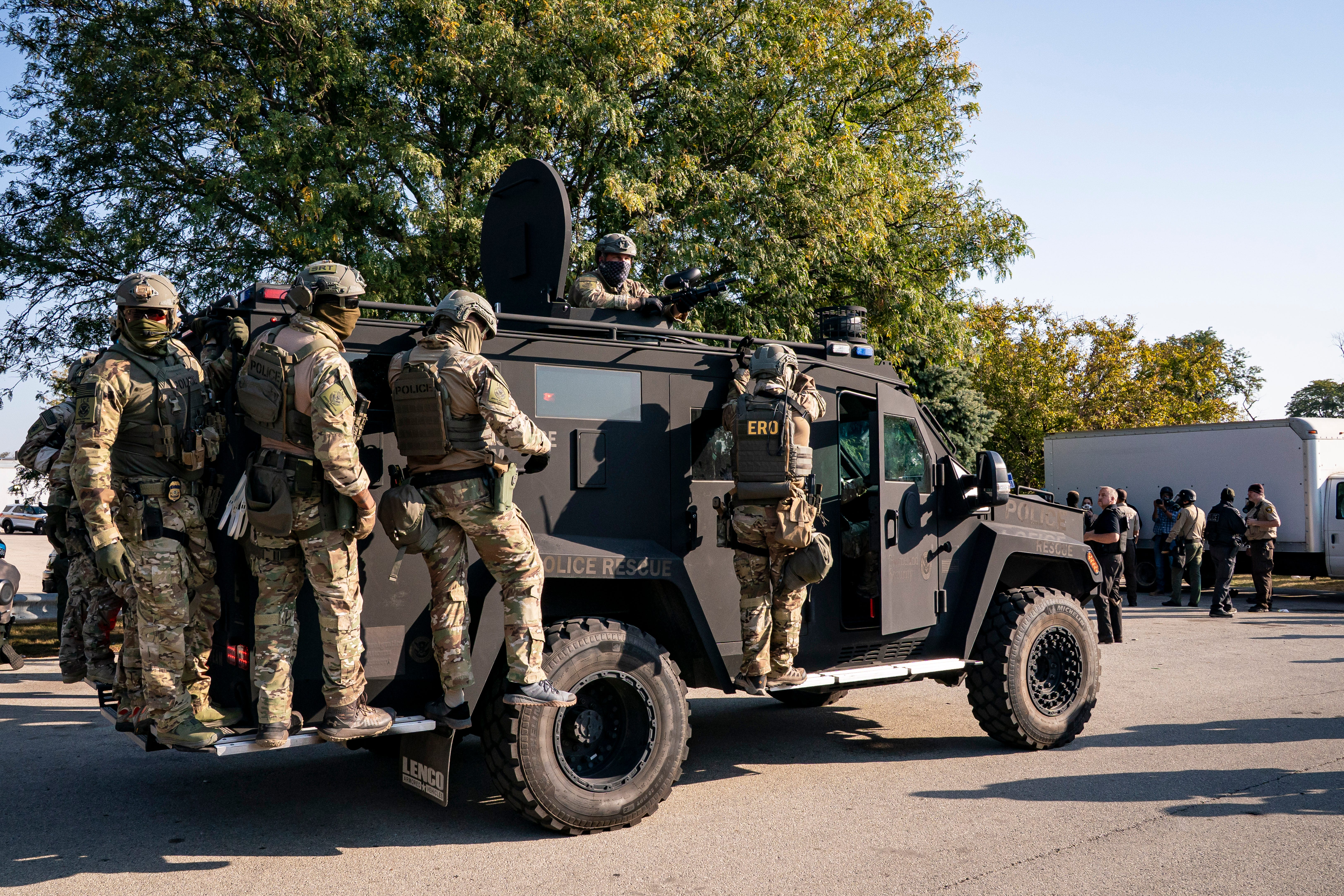
And then there’s ICE and CBP, the beating heart of the moral and constitutional crisis. The sight has become so familiar, it hardly requires explanation. Masked agents. Tactical gear. Warrantless entry. Illegal arrests of U.S. citizens. Violent assaults. Murder in broad daylight. DHS rhetoric and operational posture have blurred the line between immigration enforcement and political intimidation, with agents deployed far beyond the border and detention centers into civic spaces where constitutional protections were once assumed to be sacrosanct.
When Americans start asking, sincerely, whether the Trump administration is sliding into “Gestapo”-style policing, it’s not hysteria. It’s rational pattern recognition.
We cannot “go back to normal” after this.
Here’s the hard truth. Even if Trump vanished tomorrow, DHS would not snap back into its old shape. The firing of shock troops like Greg Bovino isn’t enough. The damage that’s been done is more than a personnel issue. It’s precedent. If I’ve learned anything in government, it’s that once “one side” does something, the other feels empowered to do the same.
Once you establish that DHS can be deployed as a partisan weapon — once you prove you can call your political enemies “terrorists,” treat cities as occupied zones, politicize disaster aid, punish dissent through immigration authorities, and dare courts to stop you — the institution is changed for good. Future presidents will have a blueprint, and ambitious political operatives will have muscle memory for how to hijack DHS powers. The temptation will remain.
So “reform” cannot mean a memo, new training, or putting people with consciences back in the job. It must mean dismantling and rebuilding, with real layers of protection put in place. The Department itself must be taken apart and put back together with the clear goal of making it harder — much, much harder — to weaponize.
So when the Trump nightmare ends, we cannot leave DHS as-is. I would propose exploration of several reforms, as a starting point:
First, split immigration off from the DHS mothership. Immigration enforcement should not sit inside the same cabinet superstructure that carries the cultural and legal authorities of “homeland security.” That fusion — border control wrapped in the language of counterterrorism — has made it far too easy for presidents to redeploy immigration powers inward for domestic political purposes. A restructured immigration agency should be independent but coordinated, more like the Federal Reserve’s relationship with Treasury, i.e. operationally insulated from day-to-day political whims, but still aligned with national policy and accountable to Congress.
Second, give more DHS agency heads an apolitical tenure. Too many powerful sub-agencies swing wildly from one administration to the next because their leaders serve entirely at the pleasure of the president. Key positions — especially at agencies like CISA, FEMA, and major enforcement components — should carry multi-year, cross-administration terms, similar to the FBI director model. That system isn’t perfect, but it makes it harder for a president to instantly convert a national security or public safety agency into a personal political instrument.
Third, supercharge the Inspector General. DHS already has an Inspector General, but the office needs more teeth, more independence, and more real-time authority. A strengthened IG should have explicit jurisdiction to investigate politicized enforcement decisions, from the allocation of FEMA disaster aid to the targeting of jurisdictions for grant cuts to the misuse of immigration authorities. Oversight can’t just be retrospective; it has to be capable of stopping abuses while they’re happening.
Fourth, revoke the president’s domestic terrorism order — and bar future ones. For years, Congress debated giving presidents more power to designate domestic groups as terrorists. Now it must do the opposite. The domestic terrorism framework advanced under NSPM-7 shows how quickly “terrorism” can become a partisan label with life-and-death consequences. Congress should explicitly rescind that authority and prohibit any president from unilaterally designating domestic political movements or protest groups as terrorist organizations.
None of this is radical. What’s radical is what we are living through.
A department born to stop another 9/11 being used to threaten Americans with watchlists, to smear people as terrorists when they inconvenience the state, and to deploy federal force as a political performance isn’t an entity taxpayers should willingly fund. It doesn’t matter if you’re a Democrat, a Republican, or an independent. You don’t want your president to be able to do this. Certainly our Founding Fathers didn’t want that.
I helped build DHS because I believed in protecting this country. Many thousands of people joined the Department for the same reason. That’s also why we must consider detonating DHS — at least the DHS we have today — and focus on rebuilding something that cannot be turned against the people it exists to serve. If we don’t do that, we’ll learn one of the most painful lessons of history: a weapon that can be pointed at anyone eventually will be.
Your friend, in defiance,

P.S. WHAT’S HAPPENING ON DEFIANCE.NEWS
Here’s what’s coming up.
TONIGHT // DEFIANCE Daily // 5p ET - Watch LIVE on our DEFIANCE.News page, on our YouTube channel, or on my X account. We’ll welcome Patrick Skinner, a former spy and counterterrorism official turned cop who will help us assess what’s going on in Minnesota and beyond.
TOMORROW // Weekly Mission Brief // 5p ET - As promised yesterday, we’ve been hard at work to announce something to curtail federal overreach in the wake of the Trump administration’s invasion of Minnesota. Tune in to find out — and to help fight back.
FRIDAY // Weekly Coffee // 2p ET - Join us for another Weekly Coffee, where you can ask questions about anything! Members-only chat. Join us LIVE on our DEFIANCE.News page, or watch the replay.
REMINDER — If you haven’t yet, get your in-person or virtual tickets to the STATE OF THE SWAMP: THE REBUTTAL TO THE STATE OF THE UNION, scheduled for February 24. This will be one of the most powerful pro-democracy events of the year.
Anyone who has studied the history of the rise of Hitler in Germany could see the rise of Hitler 2.0 right here in the USA. I saw it. When I heard trump won again in 2024 a visceral scream came from the depths of my soul and I screamed until I got hoarse. My poor husband was beside himself with concern over my reaction. I knew trump 2.0 would be a revenge game. I knew what was coming.
It's unfortunate that more whistles weren't blown after the first administration and you saw into the future. Clearly, more and louder voices were needed.
In addition to your thoughts on how to dismantle/transform the agency I believe one thing must preface this: We need a Congress that will do the job we pay them to do. Of course, we hope the midterms will put us in that direction but as of right now, there are too many in Congress who align with the authoritarian ideals. Your comment regarding bad actors of the future is one we must keep in mind. We must find a way to get past these bad actors and restore Congress. Too, I believe new laws must be put into place.
I don't expect that things will return to "normal" - if there is such a thing - in what remains of my lifetime. But my hope is for the following generations and, of course, my children and grandson.