


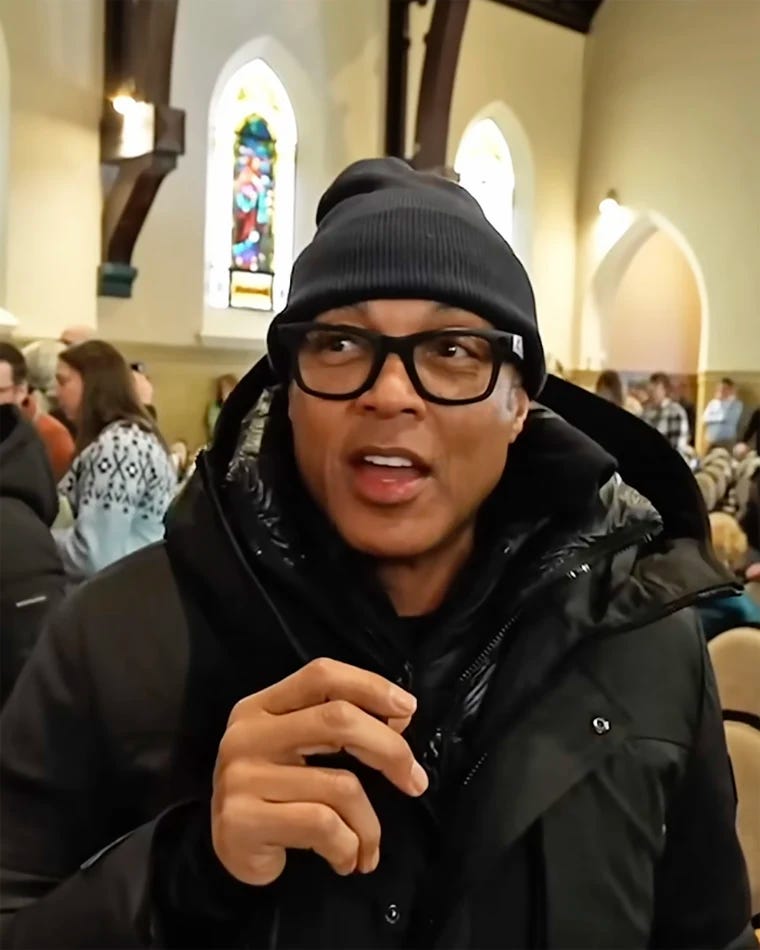
Federal agents arrested journalist Don Lemon in Los Angeles last night, according to a statement released by his attorney, Abbe Lowell, marking a dramatic escalation in the Trump administration’s long-running conflict with the press — and signaling that his war against reporters who report what he doesn’t like is now shifting to major figures in “new media.”
Lemon was in California covering the Grammy Awards when he was taken into custody, Lowell said. The arrest appears tied to Lemon’s reporting earlier this month on a controversial protest in Minnesota involving immigration enforcement. His legal team says his actions were protected news-gathering and blasted the arrest as an unprecedented attack on the First Amendment.
The other week, Lemon livestreamed a demonstration at church service in St. Paul in protest of Trump’s immigrant raids. He was covering the event as a journalist and later published the report on his Substack and YouTube platforms. Lemon said he was tipped off about the protest but didn’t know it would end up interrupting the church service. The Trump White House accused Lemon and others of trying to intimidate worshippers, and they attempted last week to get an appeals court to sign off on an arrest warrant, which the court rejected.
While federal authorities have not publicly detailed the charges, what’s clear is that this is not an isolated dispute between cops and a reporter. It’s unfolding against the backdrop of a broad and deliberate campaign by President Donald Trump to use the machinery of government to intimidate, sideline, and punish news organizations that he views as hostile.
And now, for the first time in his second term, that campaign appears to have crossed into the physical arrest of a journalist over his reporting. Behind the scenes, according to people familiar with internal Justice Department changes, the legal landscape had already shifted in ways that made such a move more likely.
Shortly after taking office, Attorney General Pam Bondi rescinded and weakened department policies that had placed additional hurdles on prosecutors seeking to subpoena journalists, seize their records, or compel testimony. Those protections had been strengthened after earlier revelations in the first Trump administration that the Justice Department secretly obtained communications data from members of Congress, their staff, and multiple reporters.
Legal experts at the time warned that rolling back those rules would make it easier for prosecutors to treat journalists less as observers and more as investigative targets. Lemon’s arrest now appears to be one of the first high-profile tests of that new posture.
Among the justifications cited in Bondi’s internal guidance were executive orders directing investigations into alleged leaks and reprisals against whistleblowers, including former cybersecurity official Chris Krebs and myself. I warned about this last August, as many mainstream media and “new media” reporters warned me that they were bracing for federal raids in the wake of the memo.
The arrest also follows a year of escalating confrontations between the White House and major media institutions — that can only be characterized as a breathtaking, full-frontal attack on the First Amendment.
For example, Trump and his allies have kicked news outlets out of the White House press pool for coverage the president doesn’t like… banned almost every major media organization from the Pentagon for refusing to sign gag orders… filed lawsuits against prominent news organizations like WSJ and BBC for reporting he doesn’t like… repeatedly threatened to revisit broadcast licensing frameworks in response to unfavorable coverage at places like CNN and NBC… pressured regulators and lawmakers to open inquiries into editorial practices at major networks like CBS… assist such allies in launching takeovers of such networks, which they did in the case of the latter… gutted publicly funded media outlets like PBS… installed MAGA-friendly media personalities inside independent U.S. broadcasting networks like Voice of America… and so much more.
Each episode, taken alone, could be framed as an aggressive but arguable use of executive power. Together, they outline a sustained effort to raise the cost of truthful journalism. What makes the Lemon arrest distinct is not just who he is, but where he sits in today’s media ecosystem.
Lemon is no longer anchored to a traditional network role. Like many high-profile journalists, he operates across platforms, including independent and digital spaces that fall outside legacy corporate structures — including right here on Substack. His case sends a signal not only to major outlets, but to the rapidly growing universe of independent reporters, newsletter writers, podcasters, and livestreamers who now perform a significant share of accountability journalism.
If the Trump regime’s theory is that being present, filming, or interviewing at a contentious event can expose a journalist to criminal liability, then the risk calculus for this entire sector changes overnight. Press freedom advocates say that is precisely the point.
“This if fucked,” a prominent press figure messaged me this morning. “They’re trying to scare people away from reporting news that the big man doesn’t like. I’ve never seen anything like it. Thuggish.”
Full disclosure: Lemon is represented by Abbe Lowell, who also represent me. His legal team has vowed to fight this case hard as an obvious test of whether the First Amendment is still operative in the United States. But even before a judge weighs in, the arrest itself has already altered the landscape.
For decades, American press freedom battles have largely played out in courtrooms and briefing rooms with subpoenas, shield laws, and source protection coming under debate in legal filings and public drama. But the image of federal agents taking a reporter into custody over his coverage represents a different, more visible form of confrontation.
It’s also a warning. The administration spent the past year turning up the pressure on large, established media organizations. Now, with the arrest of Don Lemon, it appears to be extending that pressure to the broader, more diffuse world of independent journalism. Whether that expansion is checked — by the courts or by sustained public pushback — may determine not just Lemon’s fate, but how the rest of us report the truth.
So let me say this: We will not back down. We will not be scared by these tactics. We will not shy away from reporting what Donald Trump doesn’t want to hear. And starting this very moment, DEFIANCE.org will support Don Lemon and his case in any way he needs.
Your friend, in defiance,

P.S. WHAT’S HAPPENING ON DEFIANCE.NEWS
Here’s what’s coming up.
TODAY // Weekly Coffee TIME CHANGE!!! // 12:30p ET - Join us for another Weekly Coffee, where you can ask questions about anything! Members-only chat. Join us LIVE on our DEFIANCE.News page, or watch the replay. NOTE: This will be at 1230pET today and NOT at 2pET.
TONIGHT // Weekly Mission Brief // 5p ET - We will talk about the latest with Don Lemon’s arrest — and what we can all do to protect independent journalism in this country. Watch LIVE on our DEFIANCE.News page, on our YouTube channel, or on my X account.
REMINDER — If you haven’t yet, get your in-person or virtual tickets to the STATE OF THE SWAMP: THE REBUTTAL TO THE STATE OF THE UNION, scheduled for February 24. This will be one of the most powerful pro-democracy events of the year.
We need to smack back hard in court at this.
Fight, fight, fight for our truthtellers!